
Three frontier-scale "open" models shipped within four days of each other in late July — and under three materially different grants. One can be used commercially by anyone, without conditions. One is free until your revenue crosses a threshold written into the licence. One may never earn a cent. All three were announced with the same word.
"Open" has become a ladder, not a light switch, and labs now position their releases on specific rungs of it deliberately. Knowing which rung you're looking at is the difference between a foundation you can build a product on and a research artifact you can only write papers about.
The word "open source" has an owner, and almost nobody qualifies
"Open source" isn't a vibe; it's a definition maintained by the Open Source Initiative since 1998, built on four freedoms: use for any purpose, study how it works, modify it, and redistribute it — including commercially, by anyone, forever. In October 2024 the OSI extended this to AI with the Open Source AI Definition (OSAID), and its key move was recognizing that a model isn't source code. For an AI system, exercising those freedoms requires three artifacts, not one: the weights, the training code, and enough information about the data to meaningfully recreate the system.
Hold the frontier up against that standard and almost everything falls off. Meta's Llama — the model most responsible for popularizing "open" — fails it on licence terms alone. Nearly every release this blog has covered fails it on the data leg: weights ship, code sometimes ships, and the corpus is described in a paragraph if at all. The releases that genuinely clear the bar are research artifacts like AI2's OLMo and EleutherAI's Pythia — weights, code, data, recipe, permissive licence, the lot.
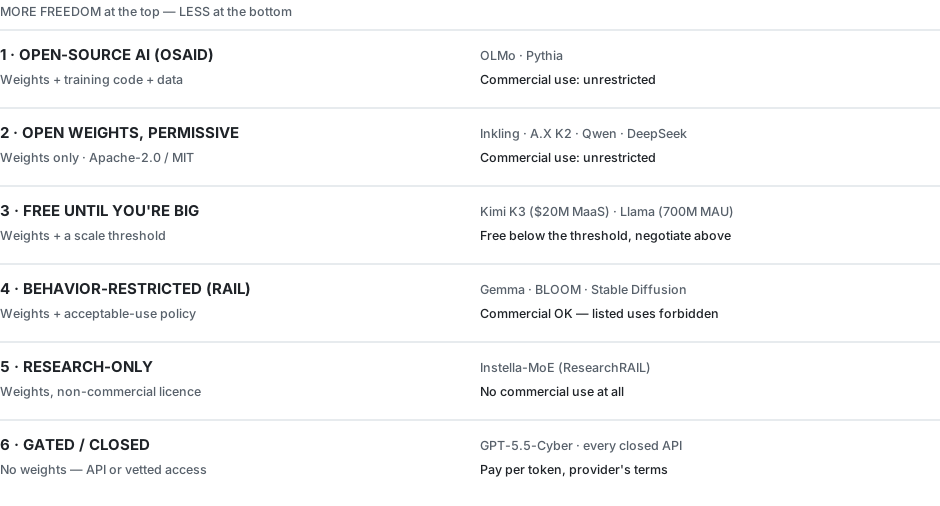
So "open source AI," used strictly, is the top rung of a ladder that most so-called open models never reach. Here's the whole ladder:
Reading the rungs — with this month's releases as the examples
Level 1 — open-source AI, strictly. Weights, training code, and data, under an OSI-approved licence. You can rebuild it, fork it, sell it, and study exactly what went into it. This is the rung research bodies occupy — OLMo, Pythia — precisely because their goal is reproducibility rather than a product.
Level 2 — open weights, permissive. The weights ship under Apache-2.0 or MIT; the code and data mostly don't. You can deploy, fine-tune, and commercialize without asking anyone — you just can't fully reproduce the model, which is the difference between owning a binary and owning a build. This is where Inkling and Inkling-Small sit, and — remarkably, at 688B parameters — SK Telecom's A.X K2, the most permissively licensed frontier-scale model to date. When a lab's announcement says "open weights" rather than "open source," this rung is usually what it means: true, and deliberately not claiming the rung above.
Level 3 — free until you're big. The weights are open and commercial use is genuinely free — below a threshold written into the licence. Kimi K3's MIT-style licence requires a separate agreement only from Model-as-a-Service operators above $20M revenue over any twelve months. Llama's community licence famously kicks in at 700 million monthly active users. This is your "if you're making money, you have to pay" tier, and the thresholds are the tell for who the clause targets: not startups, not researchers — hyperscalers who would otherwise resell the model as a competing service. For nearly everyone reading a licence like this, the practical answer is "free, including commercially." For AWS, it isn't.
Level 4 — behavior-restricted. Commercial use is allowed, but the licence polices what you build rather than how much you earn. This is the RAIL family — Responsible AI Licenses — used by BLOOM and Stable Diffusion, and in spirit by Gemma's terms of use with their prohibited-use policy. The controversy writes itself: the restrictions are mostly things nobody respectable wants to do anyway, but a licence with use restrictions is, by the OSI's definition, not open source at all — freedom zero is use for any purpose.
Level 5 — research-only. Weights you can download, study, publish about — and never charge for. AMD's Instella-MoE is July's example, under a ResearchRAIL licence, and it carries the month's best irony: the most complete release of 2026 in artifact terms — every intermediate checkpoint, the data mixtures, training and inference code — has the least free weights of any "open" model this blog covered. Openness of artifacts and openness of licence are different axes, and AMD maxed one while minimizing the other.
Level 6 — gated or closed. No weights at all: either vetted access (GPT-5.5-Cyber's identity-verified Trusted Access program) or a plain closed API. You don't license the model; you rent its outputs under terms of service that can change, or vanish — as Fable 5's nineteen-day forced suspension demonstrated to everyone building on it.
The freedoms, side by side
| Level | Use | Modify | Redistribute | Make money | Reproduce (code+data) |
|---|---|---|---|---|---|
| 1 · Open-source AI | ✓ | ✓ | ✓ | ✓ unrestricted | ✓ |
| 2 · Permissive weights | ✓ | ✓ | ✓ | ✓ unrestricted | ✗ |
| 3 · Threshold | ✓ | ✓ | ✓ | ✓ until the clause | ✗ |
| 4 · RAIL / AUP | ✓ except listed uses | ✓ | ✓ same terms | ✓ uses policed | ✗ |
| 5 · Research-only | ✓ research | ✓ research | limited | ✗ | ✗ |
| 6 · Gated / closed | via API | ✗ | ✗ | resale barred | ✗ |
Two patterns are worth carrying away from the table rather than the individual rows.
First, the licence doesn't track how big or how generous the release is — it tracks what the releasing organization wants to happen next. A 688B state-backed sovereignty model (A.X K2) is freer than a 16B research release (Instella-MoE), because Korea's Dopamo programme wants domestic industrial adoption while AMD wants citations without underwriting competitors' products. Moonshot wants rent from resellers, so K3 sits at level 3. This is the same conclusion the open-weight size analysis reached from the hardware side: scale determines who can run a model; licence determines who may.
Second, the practical question is almost never "is it open" — it's three smaller questions, answerable from any licence in about thirty seconds: Can I charge money for what I build on this? Does that stay true at any size, or is there a threshold? Is anything I might build on the forbidden-uses list? Levels 1–2 answer yes / any size / no. Level 3 answers yes / read the clause. Level 4 answers yes / any size / read the list. Level 5 answers no. Everything else is detail.
In a month when "open" was stretched over everything from a full training pipeline you can't sell to a 2.8T download with a rent clause, the rung matters more than the word. Read the licence for the three questions, place the model on the ladder, and ignore the adjective in the headline — it was chosen by the marketing team, and the ladder wasn't.