
Google DeepMind has published Bending the Curve of Discovery: AI in Science Today and Tomorrow, an essay by Alex Imas, Director of AGI Economics, and James Manyika, President of Research, Labs, Technology & Society. It draws on the companion paper, AI in Science: Early Insights (Google ATLAS, Google DeepMind and MIT FutureTech, September 2026), which combines about 15 million anonymized Gemini interactions, an inventory of 2,690 specialized AI models and a survey of 637 US and UK scientists fielded from July 27 to August 11, 2026. Headline numbers: 46.6% of scientists use AI daily, save 6.9 hours a week on average, and 43.5% say their bottleneck has moved downstream.
How AI is used in science today
Science occupations appear in Gemini usage about 2.7 times more often than in the US workforce. Within the survey, 46.6% of scientists use AI every day and another 30.6% weekly. About 70% of their AI time goes to general LLMs, for coding, writing and analysis, and about 30% to specialized models such as AlphaFold, GNoME and MatterGen. Those specialized models are well cited: 49% sit in the top 1% of citations in their field. Use scales with a country's scientific workforce.
The two tool families barely overlap at the level of individual tasks, which makes them complements. Analyzing quantitative data leads for both, at 42.7% of Gemini science logs and 73.7% of specialized-model tasks. Communicating findings is 14.1% of the logs but only 3.8% of model tasks.
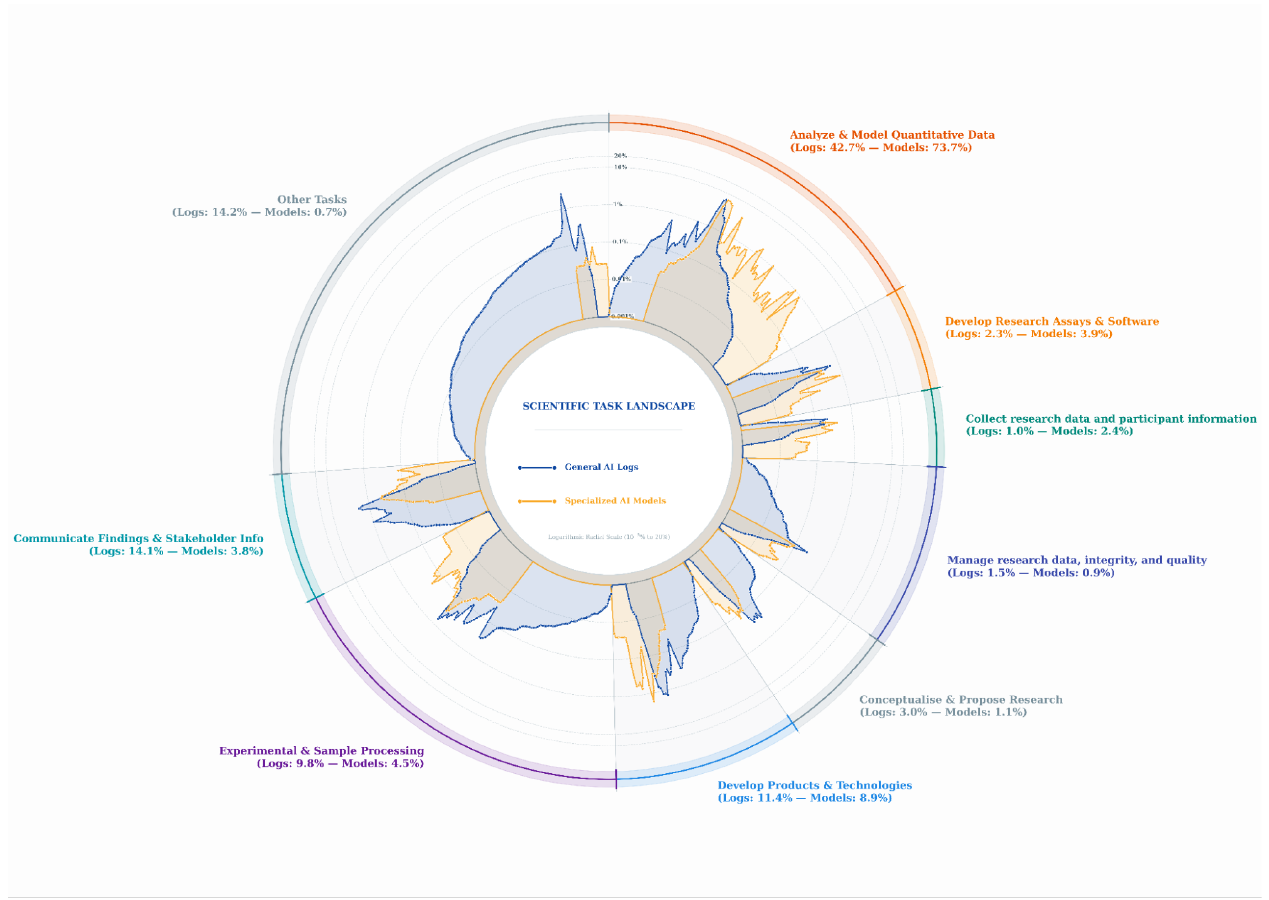
Scientific task landscape, from the companion paper (Figure 8) as shown in DeepMind's essay.
From tool to invention of a method of invention
The essay opens with Joel Mokyr's 2025 Nobel lecture: technology and science feed each other, but never automatically, and ideas are getting harder to find. Its case is that AI can become an "invention of a method of invention", like the microscope or telescope, doing more science faster and also different science.
AlphaFold is the template. Crystallographers spent decades resolving about 170,000 protein structures; AlphaFold predicted more than 200 million, and the open database has been used by over 4 million researchers in 190 countries. Basic research building on AlphaFold structures rose 15 to 40%. The essay cites the complete fly nervous system connectome and the AlphaGenome Atlas, with 9 billion counterfactual DNA changes predicted, as examples of prediction placed inside large-scale search. Google's Co-Scientist now pushes the loop into lab execution.
Other labs show the pattern. An Anthropic genome-mining study swept 1.9 billion protein clusters, where an LLM spotted a DNA-repeat anomaly and called AlphaFold 2, ESMFold and Boltz-2 to flag a family of CRISPR-like viral enzymes, covered in this blog's post. In the Virtual Lab study, LLM agents orchestrated ESM, AlphaFold-Multimer and Rosetta to design SARS-CoV-2 nanobodies.
The friction points
The workflow is inverting: in silico simulation becomes the main source of ideas, and the wet lab becomes a downstream testing step. In the survey, 43.5% say the bottleneck has moved downstream and 13.8% upstream. Meanwhile 40.5% report a bigger backlog of untested hypotheses, and 45.7% spend more than a quarter of their saved time auditing AI outputs. The essay notes that less-studied proteins drew more basic research after AlphaFold but little downstream drug discovery, with exceptions in neglected diseases such as Chagas. This echoes the evidence-chain problem in The AI Scientist's Real Problem Was Never the Science.
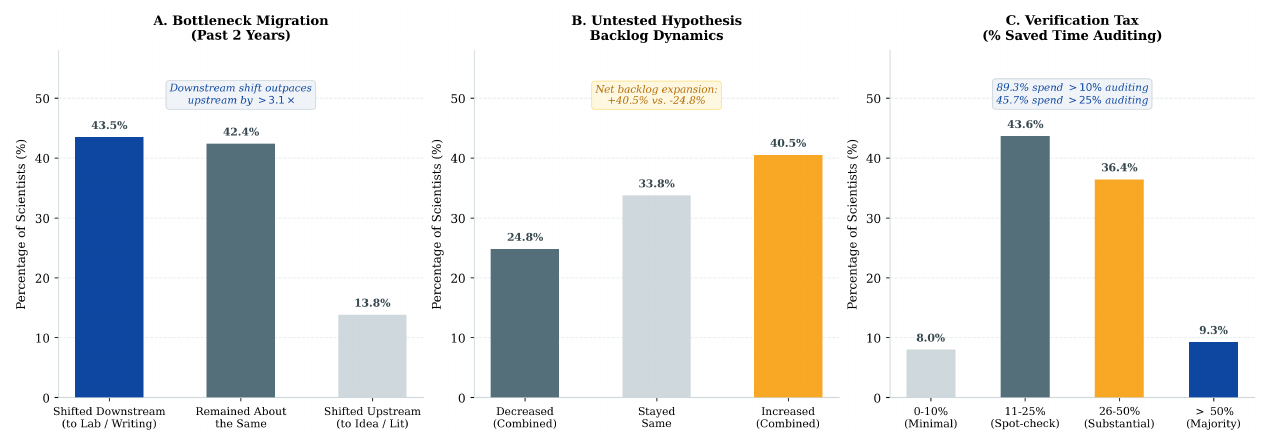
Workflow bottlenecks, untested-hypothesis backlog and time spent auditing, from the companion paper (Figure 13) as shown in DeepMind's essay.
Effects on creativity are mixed. 68.1% say AI gave them more access to other disciplines and 67.3% say it lets them ask more ambitious questions, yet 48.8% report a shift toward safer, incremental projects against 27.5% toward riskier, ambitious ones. The essay adds that the pull toward incremental work concentrates among junior researchers, and cites a related finding that AI-enabled science triples publications and quintuples citations while narrowing inquiry toward data-rich, established areas. It also flags risks to peer review and apprenticeship, and cites Pushmeet Kohli's warning of "epistemic complacency".
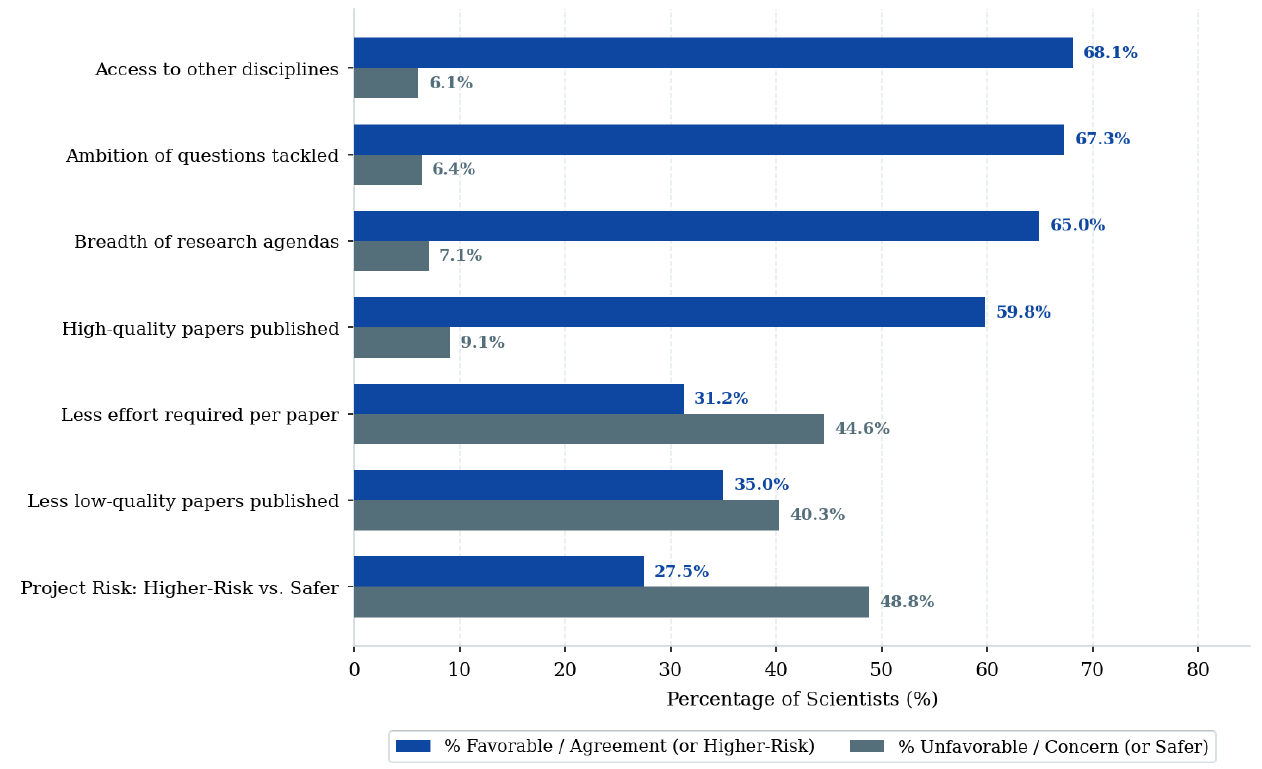
Perceived impact of AI on selected outcomes, from the companion paper (Figure 14) as shown in DeepMind's essay.
What DeepMind proposes
The essay calls for open weights, public benchmarks and version-stable research APIs, so scientists can audit bias, fine-tune and avoid reproducibility problems when models are retired. The gap is geographic: low- and middle-income countries excluding China account for about 3% of specialized-model development but about 10% of citations. For dual-use domains it recommends structured access through hosted platforms with safety screening.
Its five priorities: invest in verification and testing infrastructure; reform grants and peer review to reward moonshot exploration; institutionalize verification and safety norms, from interpretability and reproducibility to security screening; reimagine training and global diffusion through an open scientific commons; and scale translation to societal challenges that commercial players may skip. The US Genesis Mission pursues similar ground, while 25 Fields Medalists argue that solving problems was never the point.
Next comes agents that plan an experiment, call the right specialized model, cross-check and return a candidate. The scientist's job shifts toward choosing which questions to study, from Kuhn's "solver of intricate puzzles" to an "architect of profound questions". The essay's own verdict: "Our data shows we are not there yet."