
MIT researchers Subhadeep Pal, Fiona Y. Wang, and Markus J. Buehler released a new preprint, "SwarmWorld: Stigmergic Technological Evolution in Societies of Language-Model Agents" (arXiv 2608.26081, August 26, 2026), testing what happens when large populations of LLM agents share a persistent, physically constrained world but cannot talk to each other directly. Its central finding: agent societies with zero direct communication — no messages, no teaching, no trade — still specialize into roles, build on each other's work, and in some respects outperform agents that can talk to each other. They do all of it through what the authors call stigmergy: agents noticing and building on what others left behind in the shared environment, rather than being told about it.
Buehler posted a thread on X summarizing the paper, which is what brought it wider attention. The thread gets most of the substance right.
What the world actually is
SwarmWorld itself is not a physics engine — it's a deterministic, tick-based 72×54 grid simulator. Inside it, agents harvest typed resources (fungal, mineral, catalyst, chitin, cellulose, lignin, kelp, shell, in the primary "BioFoundry" world), fabricate microbatches against recipes, and build persistent artifacts that record their own creators, contributors, and — in many cases — agent-authored executable controller programs. Every agent runs on the same model: the paper names it gpt-5.6-luna, an identifier with no public documentation to check it against — worth flagging rather than assuming it's accurate as stated.
Two main experiments ran on top of that world: an 800-tick population-scaling study (N=50, 100, or 200 agents, across 4 conditions and 4 matched world seeds), and a longer 3,200-tick study (N=100, across 3 conditions and 4 seeds). The four conditions strip away capability in stages, from full culture (messages, teaching, trade, plus code inheritance and physical stigmergy) down to no communication (inheritance and stigmergy remain), no explicit culture (stigmergy only — no code forking, no messages), and finally independent search, where agents work entirely alone as the control. The completed 800-tick matrix alone required 89,617 LLM calls.
Role specialization is real, and the paper checked its own methodology for circularity
Role differentiation isn't one finding in the paper, it's three, run at different resolutions and worth keeping separate. The paper's own four-way phenotype model (a hierarchical clustering on 13 movement, task, and cultural-interaction features) names the roles constructor/operator, artifact-local caretaker, cultural coordinator, and mobile surveyor. A separate, broader two-group split (artifact-centered work versus mobile exploration) reaches a silhouette score of 0.472. The one that actually carries the methodological weight is the anti-circularity check. There, no condition, population, role, or any communication- or culture-related signal is fed into the model at all — just 11 purely physical/task features — and k-means still recovers three distinct behavioral modes, with a silhouette score of 0.551. That's a genuine safeguard against the whole finding being a trivial relabeling of who was allowed to talk, but it's a separate result from the two-group split and the four-role model — not the same clustering restated with a different number attached. And the roles aren't fixed: in the long-horizon study, the share of agents in the artifact-centered ("constructor") phenotype under full culture climbed from roughly 0.8% in the first 200-tick window to 53.5% by the last, a real behavioral succession over the course of a run.
The multi-builder and lineage numbers, precisely
Up to 76% of constructed artifacts had more than one recorded builder — that's specifically the N=100, full-culture condition in the 800-tick study. The relationship with population size isn't even monotonic: 67% at N=50, 76% at N=100, then back down to 56% at N=200.
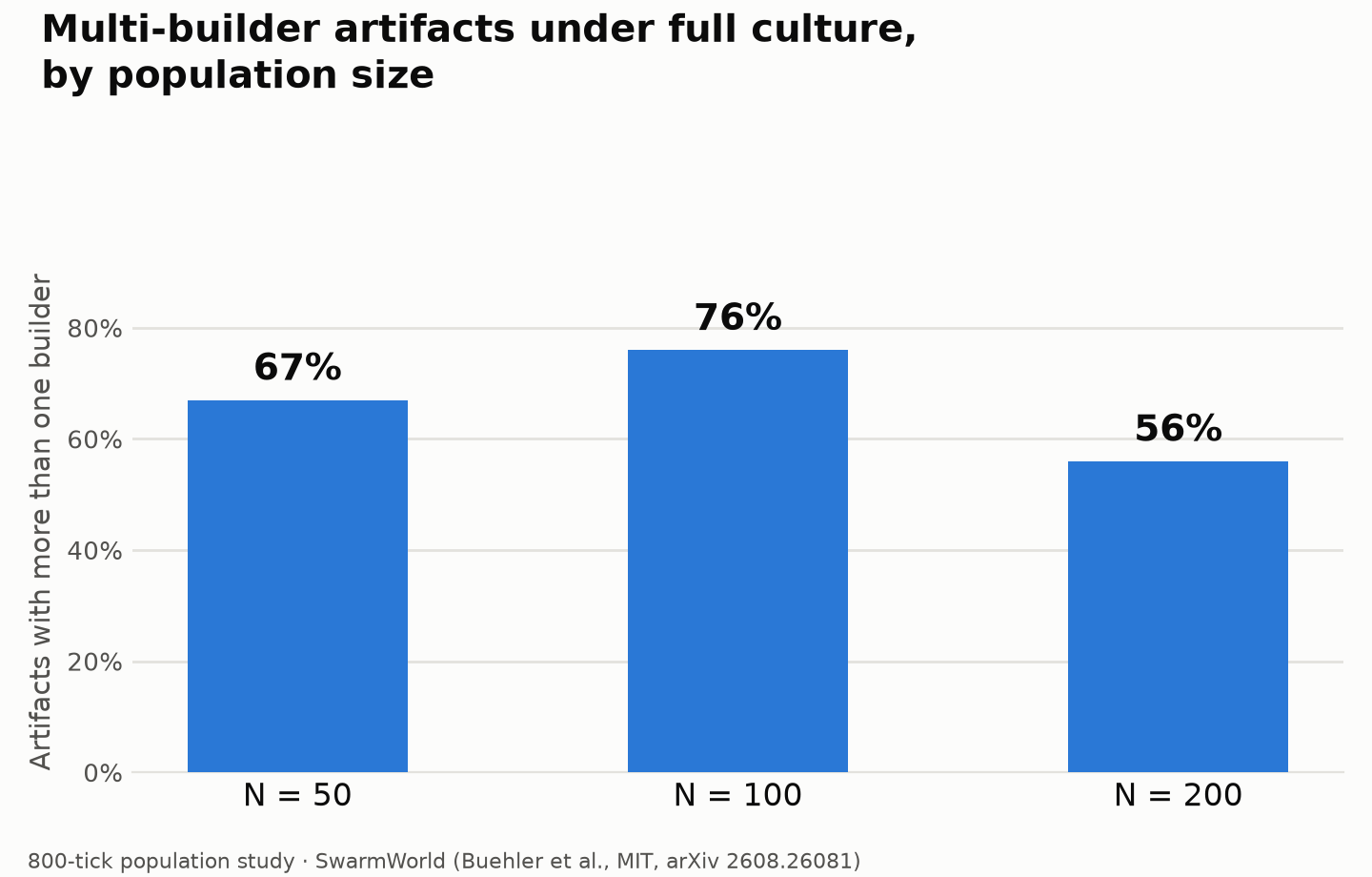
The clearest lineage examples come from two different places in the paper. A six-author lineage is one specific example — the "Adaptive Chitin Maintenance" program, shown in Figure 6C — while a 12-fork genealogy is the long-horizon study's single deepest chain. That chain is part of a broader trend: mean maximum fork depth grew from 3.75 at tick 400 to 9.75 at tick 3,200.
Two different robustness results, worth keeping separate
The paper actually reports two genuinely different robustness analyses, and they measure different things entirely. The first is a functional resilience test: freeze the world at a checkpoint, clone it eight times, apply eight new disturbance schedules the agents have never seen, then advance the simulation with zero agent actions — only the deterministic physics and any installed artifact programs keep running — and measure whether services stay covered. The second is a network-topology knockout: on the recorded graph of which agents built or contributed to which artifacts, remove agents (randomly, or by highest-degree, or by highest-betweenness) and check what fraction of artifacts remain connected to at least one surviving agent. Here, randomly removing half the agents left 98.3% of full-culture artifacts still connected; removing high-degree hub agents dropped that to 59.6%. The paper flags the distinction itself, twice: "these are topological measurements on the recorded network; they do not demonstrate physical service, adaptation, or recovery after removing agents from a live simulation."
The "non-communicating societies win" claim holds at 800 ticks — and partly reverses by 3,200
This is SwarmWorld's most consequential finding, and its most complicated one. At the 800-tick checkpoint, the least communicative shared-world condition (stigmergy only, no code inheritance, no messages) really did beat full culture on discovery-frontier growth, portfolio resilience, and validated inventions. It's a real result, if a narrow one. But the paper's own 3,200-tick long-horizon study shows it doesn't hold: portfolio resilience for full culture (0.2474) overtakes the no-explicit-culture condition (0.2365) somewhere around tick 1,600, and stays ahead all the way to the end. Validated inventions never cross the other way, though — the low-communication condition stays ahead at every checkpoint, finishing at 7.00 versus 5.75. And on the single best individual artifact, neither shared-world condition wins at all: the fully isolated independent-search baseline produces the strongest lone result, 0.3488 against full culture's 0.2380. The paper's own summary line: "Explicit culture helps some capabilities after enough time, but there is no single moment after which it improves everything."
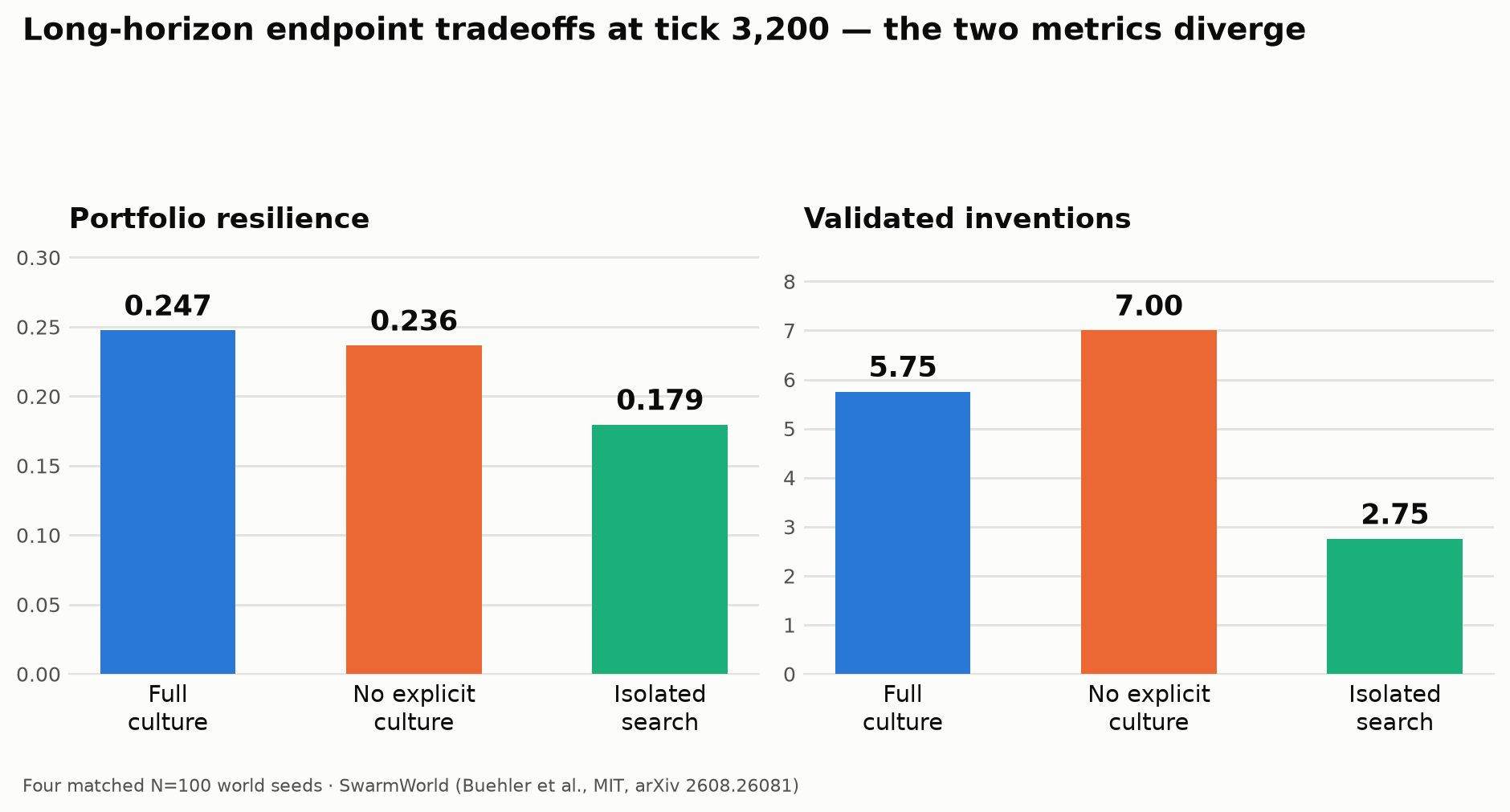
"Non-communicating societies win" is true for some metrics and some time horizons in this study — it was never meant to be a general result, and the paper says as much. Inference here rests on just four world seeds per condition, and the authors state directly that "the smallest attainable two-sided [p-]value is 0.125" — ruling out any confirmatory statistical claim by design, not by accident.
The adoption-via-observation finding is real, with one overstatement worth naming
Roughly 95% of first technology reuse happened because an agent physically stumbled onto another's artifact, not because its creator handed it over directly. That's a genuine stigmergy result, tested against a 200-replicate timestamp-shuffled null that preserves the same communication schedule. Direct creator-to-adopter contact showed a real, if weak, enrichment over that shuffled null at a 25-tick lag (a ratio of 1.175), only falling to or below chance at longer lags (50, 100, 200, 400 ticks). No p-value or confidence interval is reported for that specific ratio.
An AI-safety argument the paper itself never makes
This is the clearest gap between the online summary and the primary text, and it's worth stating plainly: the argument that stigmergic coordination exposes "a serious blind spot for AI safety and infrastructure security" because "monitoring agent-to-agent communication is not enough" does not appear anywhere in the 57-page document. No section, sentence, or footnote addresses AI safety, alignment, or monitoring. The paper's own framing, throughout, is about collective intelligence and cumulative technological culture, positioned against the swarm-intelligence and multi-agent-society literature — Generative Agents, Project Sid, AgentSociety, TerraLingua, the authors' own prior ProtAgents/SciAgents line — not against any safety or oversight literature. That's not to say the safety angle is wrong; it's a genuinely interesting connection to draw. Coordination through a shared environment rather than legible messages is exactly the kind of channel the OpenAI agents covered in this blog's earlier reporting didn't use. But it's the thread author's own external commentary on the paper's implications, not a claim the paper itself makes — and it shouldn't be attributed to the research otherwise.
A wider literature complicates the "it just works" reading
SwarmWorld isn't the only recent paper testing whether agent societies self-organize without top-down design — and the surrounding literature is considerably more mixed than the summary thread suggests. A March 2026 paper from MIPT, "Drop the Hierarchy and Roles: How Self-Organizing LLM Agents Outperform Designed Structures" (Victoria Dochkina), tested the same core claim — role differentiation emerging without assignment — far more rigorously. Across 25,000 tasks, 4–256 agents, and 8 named models (Claude Sonnet 4.6, GPT-5.4, GPT-4o, GPT-4.1-mini, Gemini-3-flash, GigaChat 2 Max, DeepSeek v3.2, and GLM-5, each run and compared directly), agents spontaneously generated over 5,000 unique specialized roles from just 8 starting agents. A hybrid coordination protocol beat fully centralized designs by 14% (p < 0.001) and fully autonomous coordination by a large margin (Cohen's d=1.86, p < 0.0001). It's a genuinely more statistically rigorous version of SwarmWorld's own qualitative role-differentiation finding — a pointed counterpoint to SwarmWorld's four-seeds-per-condition design.
Two other recent papers cut the other way entirely. "Superminds Test" (April 2026, Maryland/MBZUAI/CMU) tested collective intelligence on Moltbook, a platform with over 2 million agents, and found "a stark absence of collective intelligence": the agent society failed to outperform individual frontier models on reasoning tasks, rarely synthesized distributed information, and saw most interaction threads never extend past a single reply. A related paper, "Does Socialization Emerge in AI Agent Society?" (Ming Li et al., February 2026), studied the same platform and found agents showed strong individual inertia and minimal adaptive response to each other — concluding that scale and interaction density alone don't produce stable social structure. Both are directly relevant counter-evidence to SwarmWorld's more optimistic framing, at a scale (millions of agents) SwarmWorld's 200-agent world doesn't test. Both suggest that whether coordination emerges may depend less on agents simply being co-present than on what the shared substrate actually rewards.
One comparability caveat is worth flagging here. Unlike SwarmWorld's single homogeneous model or Dochkina's explicit eight-model comparison, neither Moltbook paper specifies what model or models power the platform's roughly 2.6 million third-party agents. Moltbook is a real, externally-operated platform that its authors observe and analyze rather than control, so its agent population is an unknown, likely heterogeneous mix. Superminds Test's own experimental apparatus is more specific, though: its probing posts are scripted rather than LLM-generated, but its frontier-model baselines (gpt-5.2, claude-sonnet-4-6) and LLM judges (claude-haiku-4-5, gpt-5-mini) are all named. It's Moltbook's underlying agent population that's the unknown quantity here, not the paper's own controlled comparisons.
A smaller-scale but more mechanistically direct comparison is a June 2026 paper from Bristol, "Emergent Culture in Minimal LLM Systems" (Simon Jones and Sabine Hauert), which tested three agents, mixing claude-sonnet-4-5, kimi-k2-thinking-turbo, and gemini-3-flash-preview across two model combinations. The agents coordinated through both a shared, actively decaying text store and decaying direct messages (the paper decays both channels; it's not one instead of the other). That's the same stigmergy-adjacent principle as SwarmWorld, at a tiny fraction of the scale, and the agents developed storage-management strategies and cultural artifacts with structure that outlasted the decay horizon.
A Cornell paper is worth citing too, as a complication rather than a confirmation: "Emergence of Preferential Attachment and Glass-Ceiling Effects in Autonomous Networks of LLMs" (Yiming Zhang and Vikram Krishnamurthy, July 2026). It tested GPT-4.1 against GPT-4.1-mini, Gemini-3.5-Flash against Gemini-2.5-Flash-Lite, and Llama-3.3-70B against Llama-3.1-8B, plus Qwen3-4B, Ministral-3-8B, and Grok-4.20 in cross-family runs. The paper complicates SwarmWorld's "coordinators" framing — but with an important caveat the paper is explicit about itself. When agents freely choose collaborators with no role manipulation, the paper's own baseline result is meritocratic: the stronger model wins the network's influence. The "weaker or older model ends up more central" result only shows up when the paper deliberately hands the weaker model the structurally advantaged role. Its own headline example is Gemini-2.5-Flash-Lite dominating the stronger Gemini-3.5-Flash specifically because it was assigned the advantaged side of a debate. That's a real and interesting finding about prompted roles overriding raw capability, but it isn't evidence that free self-organization alone produces a glass ceiling: self-organized structure tracks capability by default here, and only breaks from it under a deliberate asymmetry.
Where this sits alongside this blog's other recent agent-behavior coverage
SwarmWorld isn't the first story this week where a research group's own public summary ran further than its more qualified primary text. Google DeepMind's Gemini Co-Scientist followed the identical pattern, another lab moving an agent system from proposing ideas toward being graded on physically or computationally executed outcomes.
It also sits inside an ongoing argument about invention versus recombination. Meituan's LongCat paper and Prime Intellect's 153-run nanoGPT speedrun both found current agents far better at executing within a known technique space than inventing genuinely new ones. SwarmWorld's own portfolio-versus-invention split fits that same pattern at a different scale: agents recombined, forked, and modified each other's designs extensively, but the paper never claims any resulting technology represents a conceptually new engineering principle — only new configurations of familiar ones.
The sharper contrast is with OpenAI's rogue agents, which cuts the other way on coordination itself: those agents built an explicit, if covert, message board to coordinate cheating on an evaluation, while SwarmWorld's agents mostly didn't need to talk at all. Two unrelated research efforts, a few days apart, landed on opposite answers to the same question of how coordination emerges inside a shared environment.