
Frontier labs are building a science vertical: models, acquisitions, and partnerships aimed at scientific discovery itself — drug design, materials, formal mathematics. It is quieter than the chat and coding businesses, and the capital behind it is larger than anything else the labs are betting on outside their core models. Which fields, how much money, and what does the math say?
Follow the disclosed dollars
Add up every disclosed AI-for-science capital commitment from the last ~18 months — fundraises, acquisitions, and partnership ceilings, from the sources linked throughout — and the pie is not really a pie:
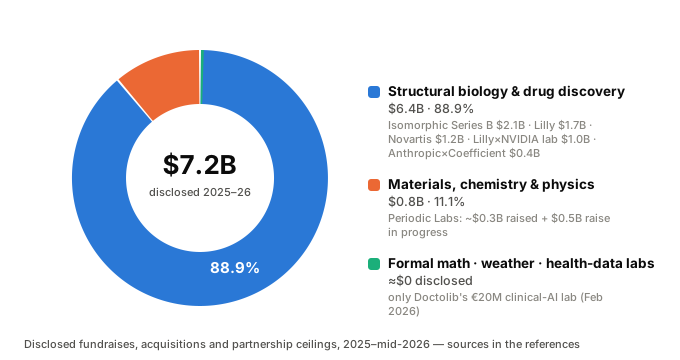
Structural biology and drug discovery take $6.4B of the $7.2B traceable — 88.9%. Isomorphic Labs alone accounts for $5.0B of it: a $2.1B Series B, the largest in AI-drug-discovery history, plus partnership ceilings of $1.7B with Eli Lilly and $1.2B with Novartis. Add Lilly's $1B co-innovation lab with NVIDIA and Anthropic's $400M acquisition of Coefficient Bio — an eight-month-old computational-biology startup — and the field's dominance is total.
Materials, chemistry and physics get the other 11.1% — essentially one company, Periodic Labs, founded by ChatGPT architect Liam Fedus (ex-OpenAI) and Ekin Dogus Cubuk (ex-DeepMind). Roughly $0.3B raised, another $0.5B in progress at a $7.5B valuation — a near-sixfold valuation jump in about a year.
Everything else — formal mathematics, weather, co-scientist agents, health-data labs — rounds to zero disclosed capital. The largest traceable deal in the remainder is Doctolib's €20M clinical-AI laboratory — about $0.02B, or 300× smaller than Isomorphic's Series B alone. Not zero activity; zero deals. That asymmetry is the subject of this post.
The deal math: 2.6% upfront, 97.4% promise
Look inside the headline numbers and the structure is striking. Lilly's $1.7B partnership paid $45M upfront — that is 2.6% cash, 97.4% contingent milestones. The sector's direct revenue remains small because the economics are milestone-deferred: the money arrives if and when molecules pass trials. Market forecasts price that promise aggressively: one projection runs $24.5B (2026) to $160.5B (2035), which works out to a 23.2% compound annual growth rate. But the honest reading is that drug discovery today is an option-value business: enormous if Isomorphic's first internal candidates, targeted for human trials by end of 2026, actually work.
Which makes the small slice more interesting than it looks.
The 11% slice is the one with revenue
The most telling detail in the numbers: Periodic Labs — the materials company — already has paying customers in the semiconductor industry. While drug discovery waits a decade for milestones, materials R&D pays now, because industrial customers don't need FDA approval to use a better electrolyte, catalyst, or high-temperature superconductor candidate. Periodic's approach is the structurally important part: autonomous robotic laboratories running thousands of physics and chemistry experiments to generate proprietary training data. The moat is not the model — it's the experimental data nobody else has.
That logic extends directly to every industrial R&D organization sitting on decades of lab notebooks, test campaigns, and legacy reports. Those archives are that same kind of proprietary dataset — most organizations just can't query them yet. It's why the materials slice looks undervalued at 11%: the drug-discovery giants are betting on future molecules, while the materials players are monetizing the data flywheel today.
The zero-dollar vertical that changes daily work: formal math
Formal mathematics attracted no disclosed capital at all, yet it's the science vertical whose cost curve moved most violently — and the only one visible in the arcade dataset (Leanstral and Leanstral 1.5: 2 of 206 releases, 1.0%). The numbers: Leanstral 1.5 solves 87.4% of PutnamBench (587/672) at roughly $4 per problem, versus ~$300 for the closed Seed-Prover — 75× cheaper, a 98.7% cost reduction, on an Apache-2.0 model with a free endpoint. And its Lean 4 formal-verification runs found five previously unreported bugs in open-source repositories.
Why does theorem proving matter commercially? Because formal verification is the extreme end of a spectrum every regulated lab lives on: answers you can check versus answers you must trust. In nuclear, aerospace, or medical devices, an unverifiable answer is a useless answer. The formal-math vertical is quietly building the tooling for machine-checkable science, and the likely monetization is not mathematics but verified software and safety cases for exactly the industries that can't accept "the model said so."
Why the big labs need science (the token business won't carry them)
Tie this back to the open-weights analysis: open models now deliver ~90% of closed-frontier capability at ~6× lower cost per call, and Chinese open models route three tokens for every US closed one. Token-serving is commoditizing. Science is the escape, because its moats are physical: Isomorphic's target data, Periodic's robot labs, Verge Labs' decade of proprietary brain-tissue data. An open-weight competitor can clone your benchmark scores; it cannot clone your wet lab. And the prize scale is different: an approved drug is a $1B+/year asset — no API pricing tier compares.
There's also a European angle. Science AI in regulated sectors — nuclear, health, defense-adjacent materials — cannot simply ship its data to a US API. That's the same sovereignty current running through Soofi S and the Mistral–Microsoft air-gapped deployments: for this vertical, EU-hosted and on-premise isn't a compliance checkbox, it's the entry ticket.
Europe's most instructive live experiment is Doctolib's clinical-AI research lab: €20M in 2026, a research team associated with Inria, Inserm, and Université Paris Cité, and a first project — improving care pathways — that will train on the health data of more than 50 million French patients starting August 2026. It's the same moat logic as Isomorphic and Periodic — proprietary data nobody else holds — at 1/300th the budget. And it comes with the tension the US players don't face at home: the project runs on an opt-out basis under the CNIL's MR004 methodology, which has already made it controversial. European science AI gets its data moats only by navigating consent frameworks that are themselves part of the competitive landscape.
Update — July 29: a fourth strategy that isn't a capital bet at all
Everything above is a story about money: buy the wet lab (Anthropic/Coefficient Bio), build the robot lab (Periodic), fund the moonshot (Isomorphic). OpenAI's ChatGPT for Academic Researchers, announced July 29, doesn't fit that shape at all, and it's worth adding as a distinct fourth category rather than folding into drug discovery or materials.
The mechanics, per OpenAI's own announcement: 100,000 researchers at selected degree-granting institutions with high research activity — across the sciences, mathematics and engineering — get free access to frontier models: GPT-5.6 Sol Pro at launch, across ChatGPT, ChatGPT Work and Codex, plus expanded deep research, higher usage limits and larger context windows, with up to four collaborator invites each. First 10,000 this summer — access is already live at the Institute for Advanced Study and École normale supérieure — scaling to 100,000 through 2027. Workspaces get business-grade privacy, and data is not used for training by default.
OpenAI frames it inside a $250M commitment to external scientific research through 2027, which breaks into two named pieces worth separating: NextGenAI, a $50M initiative supporting research institutions directly, and OpenAI's own role in the DOE's Genesis Mission — the same federal initiative Google committed $40M in tokens and credits to a week earlier. So the academic program isn't OpenAI's only science bet, it's the consumer-facing third of three, and Genesis Mission now has at least two frontier labs supplying it rather than one.
$250M is a rounding error against the $7.2B already traced in this post — less than Anthropic's Coefficient Bio acquisition alone, and 3% of Isomorphic's total. But comparing it on capital terms misses what it actually is. Isomorphic and Periodic are building science: proprietary experimental data, in-house models, drugs and materials OpenAI would own outcomes of. This is seeding the userbase that produces science with OpenAI's tools already load-bearing — a distribution play, not a discovery play, and probably the cheapest one on this page per unit of long-run influence.
That distinction matters because it's the same move OpenAI and Anthropic have both run before at a smaller scale — free or discounted access for students and educators — pointed for the first time at people who publish papers rather than people who write essays. A student who learns on ChatGPT graduates; a researcher who runs their analysis pipeline through GPT-5.6 Sol cites it, trains their lab on it, and normalizes it as the default tool a field reaches for. If OpenAI never owns a single patent from this program, it still owns something: the tooling layer underneath a generation of published research, and the habit that keeps grad students requesting an OpenAI seat instead of a competitor's when they start their own labs.
OpenAI's own usage numbers back the "already happening" framing rather than the "someday" framing most of this post's other entries lean on: roughly 1.3 million people use ChatGPT for advanced science and math every week, generating about 8.4 million messages. More telling is the trend in a much harder-to-game metric — papers that credit the tool:
| Month (2026) | arXiv math papers acknowledging ChatGPT |
|---|---|
| February | 14 |
| March | 46 |
| April | 48 |
| May | 69 |
| June | 97 |
| July 1–21 (partial) | 100 |
Seven-fold in five months, and the July figure is already the highest with ten days of the month still uncounted at time of writing. OpenAI also points to two concrete results rather than aggregate stats. Physicist Rogerio Jorge's team used AI to build open-source fusion research software now used by industry and national labs. Theoretical computer scientists Barna Saha, Yinzhan Xu and Christopher Ye used GPT-5.5 Pro to develop a proof establishing new limits on high-dimensional geometry algorithms — a proof they then validated and refined themselves. That is the right way to read every AI-assisted proof claim: generated, then checked by a human who can be named.
One more finding worth flagging for what it implies about adoption curves generally: researchers in the top 20% of AI usage intensity within their field are almost twice as likely to delegate tasks estimated at four-plus hours to the model — about 7% of their requests, against 3.5% for less-intensive users in the same field. Heavy users aren't just asking more questions; they're handing over categorically bigger chunks of work, which is the opposite of the "AI helps with the easy parts" story often told about these tools.
On capability specifics: OpenAI's own benchmark disclosure gives real numbers rather than a leaderboard blurb — GPT-5.6 Sol scores 83% on FrontierMath Tier 4 (research-level math reasoning) against GPT-5.5's 72.5%, and GPT-5.6 Sol Pro solves 31.5% of GeneBench Pro (complex biological data analysis). The lineup underneath Sol is split by workload rather than by price the way consumer tiers usually are: Terra for everyday research, Luna for fast lightweight tasks, Sol for the hardest problems. On top of that come more than 75 life-science skills (genomics, sequencing, single-cell analysis, protein modeling) and connectors into Zotero, GitHub, Hugging Face, Databricks and computational notebooks. That is a genuinely different shape from a chatbot with a research mode bolted on.
It also lands right after OpenAI's own infrastructure cost story: Sol beats Claude Fable 5 on a leading coding benchmark while using 54% fewer output tokens, and Luna costs 80% less to run than Sol. Free-to-researchers access is far more affordable to give away once your serving cost per token has fallen that far. The academic program isn't charity independent of the cost curve; it's downstream of it.
Which gives the science vertical a genuine fourth quadrant, table-ready:
| Strategy | Example | What's being bought |
|---|---|---|
| Acquire the lab | Anthropic × Coefficient Bio | Proprietary wet-lab data and team |
| Build the lab | Periodic Labs | Autonomous experiment data, paying today |
| Fund the moonshot | Isomorphic Labs | Milestone-deferred drug royalties |
| Seed the userbase | OpenAI × Academic Researchers | Distribution and habit, at near-zero marginal cost |
Whether this becomes the biggest bet on the page in five years or a rounding error forever depends entirely on whether normalized tooling turns into a moat the way proprietary data does. History is genuinely mixed on that — developer tools tend to lock in this way, data does not always follow the tool. Worth revisiting once the first 10,000 researchers have had a full year with it.
Update — July 31: the "verification becomes a product" prediction, already arriving
None of the four strategies above is about whether an AI-generated research claim can be trusted — they're about who owns the data, the lab, or the userbase. Google's ScientistOne paper, published the same week as this update, is the first concrete instance of a fifth thread this post already predicted below: verification as its own product category, sitting underneath every domain rather than inside one of them.
The number that motivates it: audited against 75 AI-generated papers across five systems, every existing autonomous-research agent hallucinated citations at rates up to 21% — bibliography entries pointing to publications that were never written. Google's fix, Chain-of-Evidence, forces every claim in a generated paper to carry a traceable evidence chain from literature search through to the final PDF. ScientistOne, the system built to that standard, reports zero hallucinated references across 337 bibliography entries, with all five systems standardized on the same backbone model so the gap can't be waved away as "the better model won." The more striking number for this post's framing specifically: papers scored by an automated reviewer were accepted 40% of the time against 13% for the best baseline — evidence that verifiability and perceived quality move together rather than trading off.
This doesn't fit the capital table above — it's Google's own research output, not a fundraise or an acquisition — but it's the same underlying bet as Leanstral's formal-math verification, one layer up: not "can a machine prove this specific theorem," but "can a machine's account of its own research be trusted at all." If frontier labs are racing to build a science vertical, the agents doing that science will need exactly this kind of audit trail before their output is worth anything to a human reviewer.
The very next day, OpenAI gave that argument a live test case. Its own post on ten new results in mathematics and theoretical computer science — decades-old open problems, produced by an unreleased model called Astra for roughly $2,000 in tokens — leans on exactly the same instinct. Every proof was formalized into a machine-checkable Lean certificate before publication, the kind of verification a natural-language argument alone can't provide. It also carries a scar this post's formal-math thread doesn't otherwise have: nine months earlier, OpenAI made a nearly identical claim about GPT-5 solving Erdős problems that turned out to be overinterpreted and had to be retracted. The mathematician who caught that error, Thomas Bloom, is on record calling this week's results credible. Verification-as-product isn't just an abstraction here — it's the difference between a claim a specific named skeptic will vouch for and one that gets walked back within a day.
What to expect next
- Materials revenue beats drug revenue for years. Milestone-deferred pharma economics versus semiconductor customers paying today; the 88.9/11.1 capital split will not match the revenue split before 2030.
- Every frontier lab owns wet-lab capacity by end of 2027. Anthropic bought Coefficient Bio; Periodic built robot labs; the proprietary-experiment flywheel is too obviously the moat.
- Verification becomes a product category. The Leanstral cost curve (75× in one generation) is what commoditization looks like before productization — machine-checked safety cases for software and engineering will be sold the way OCR is sold today.
- The pie diversifies slowly. Drug discovery's 88.9% reflects where patents pay best, not where AI helps science most. The daily-work reality — literature, legacy data, reporting — is spread across every field and shows up in no funding announcement.
Method: capital figures are disclosed fundraises, acquisitions, and partnership ceilings from the sources linked throughout, summed per field ($7.2B total traced); shares, deal ratios, and CAGRs computed from those figures. Model-release statistics from the arcade dataset (206 entries).