
After fitting curves to the whole arcade dataset, I wanted to test a sharper hypothesis: that open-weight models are going heavyweight — trillion-parameter scale — while staying competitive with the closed frontier and monetized through APIs. So I tracked down the parameter count of every open-weight release in the dataset — 93 of 102 resolved. The sizes now live in the arcade database itself, as params_B and active_B fields, so future analyses get them for free.
Two terms matter before the math. These are open-weight models — weights downloadable under Apache 2.0, MIT, or custom licenses — which is not the same as open-source in the full sense (weights plus training data plus code; only OLMo 2, BLOOM, and Soofi S really qualify). And for the big ones, size means two numbers, not one: total parameters (what you store) versus active parameters per token (what you compute), because every model at this scale is a sparse Mixture-of-Experts.
The frontier doubles every 13 months
The running maximum of open-weight model size is startlingly regular: BLOOM 176B (2022) → Falcon-180B → Grok-1 314B → Llama 3.1 405B → DeepSeek-V3 671B → Kimi K2 1T (July 2025) → DeepSeek v4 1.6T → Kimi K3 2.8T (last week). An exponential fit through those frontier points gives ×1.9 per year — doubling every ~12.8 months — with R²=0.91. Extrapolated, the largest open model crosses 5T in early 2028 and 10T a year later. Qwen3.8's promised open release at 2.4T would land almost exactly on the curve.
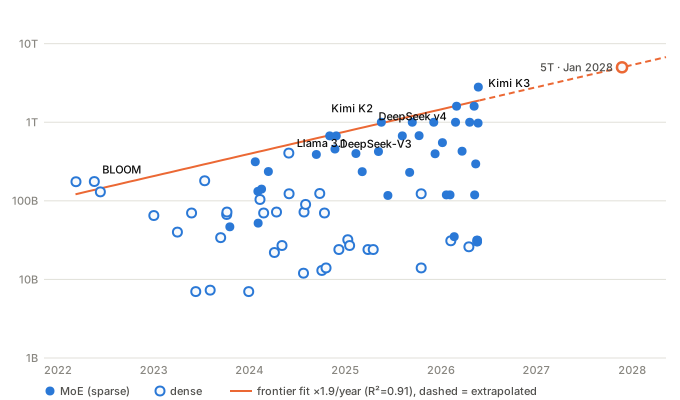
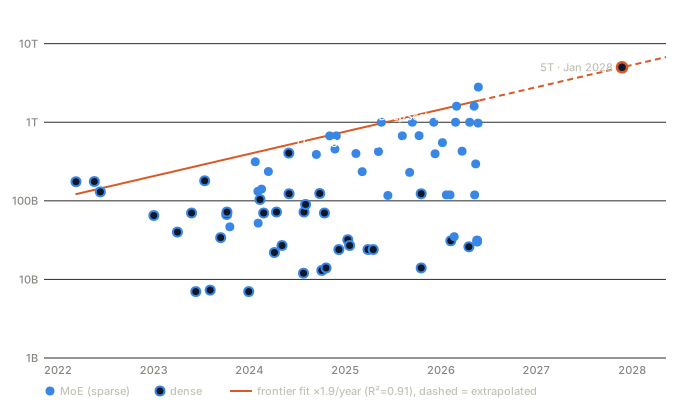
The median release moved too: 65B (2023) → 90B (2024) → 235B (2025) → 295B (2026). The heavyweight shift is not just the frontier — the whole distribution slid up.
The sparsity scissors — why "free weights + paid API" works
Here's the mechanism that makes trillion-scale open weights economically rational rather than charity. Since early 2024, total parameters of the big open MoEs grew ~16×. Active parameters didn't move: they've stayed in a narrow ~30–55B band the entire time. Grok-1 ran 27% of its weights per token; DeepSeek-V3 cut that to 5.5%; the 2026 trillion-class runs ~3%; Kimi K3 activates 1.8% — 50B of 2.8T.
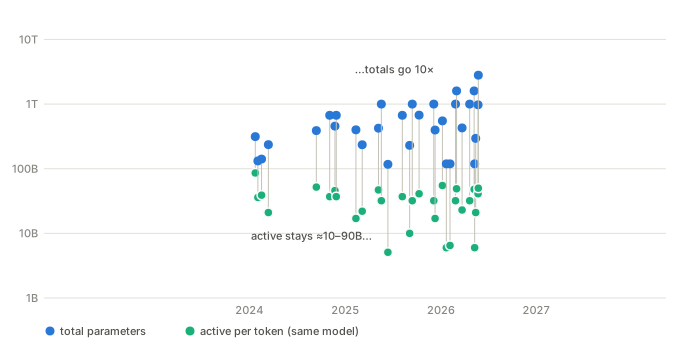
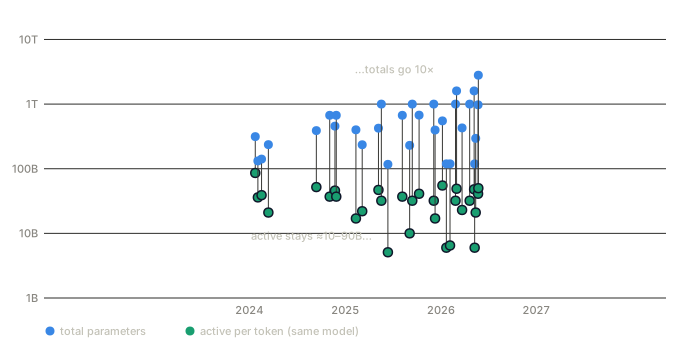
Serving cost scales with active parameters, so a 2.8T model costs roughly what a 50B dense model costs per token to run — but almost nobody else can afford the ~1.4TB of accelerator memory to hold the weights. Which means a lab can give the weights away and keep the API revenue: openness as marketing and ecosystem play, hosting as the business. That's exactly the pattern in the data — K3 at $15/M output tokens, GLM's Coding Plan, Qwen's Token Plan, DeepSeek V4 Pro at $1.74/$3.48 per million — and it's why "comparable to closed, but available via API" isn't a contradiction. It's the design.
And they are comparable now: K2.6 ties GPT-5.5 on SWE-Bench Pro at 80% lower cost, LongCat-2.0 beats it outright (59.5 vs 58.6), K3 sits third on GDPval behind only Fable 5 Max and GPT-5.6 Sol Max — ahead of Opus 4.8. Independent tracking puts open models at ~90% of closed capability for ~6× less per call, with Chinese open models routing ~18T tokens a week against 5.5T for US closed models.
The trillion tier, from zero to category in twelve months
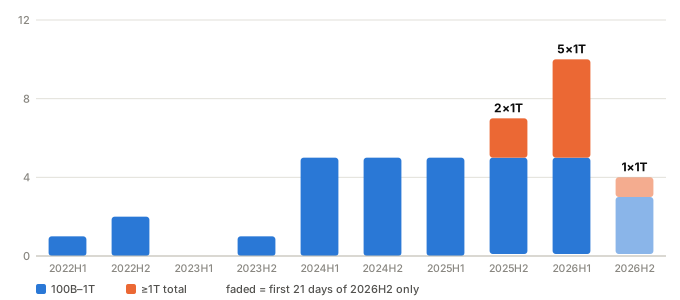
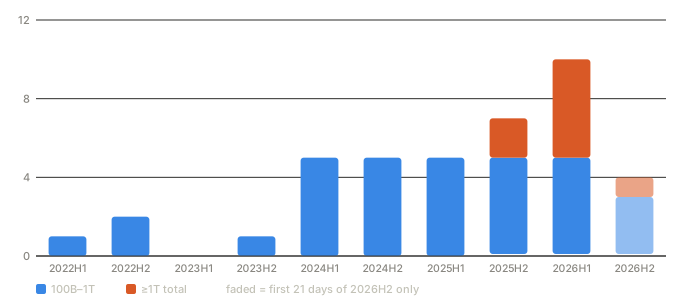
No open model had crossed 1T before July 2025. Since then: eight — Kimi K2, K2 Thinking, K2.5, K2.6, K2.7-Code, DeepSeek v4, LongCat-2.0, and K3, with Inkling at 975B a rounding error away and Qwen3.8 (2.4T) promised.
But can you actually run any of this?
Classify every open language release by the cheapest hardware that can realistically run it at 4-bit quantization. The rule of thumb is ~0.58 GB per billion parameters: a 24GB RTX 4090 fits ~32B total, a 32GB 5090 ~48B. A sparse MoE runs at usable speed on CPU only if its active count is a few billion — you still need RAM for all the weights, but the compute per token is small:
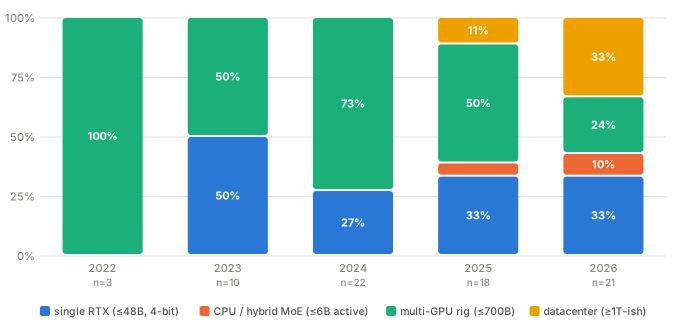
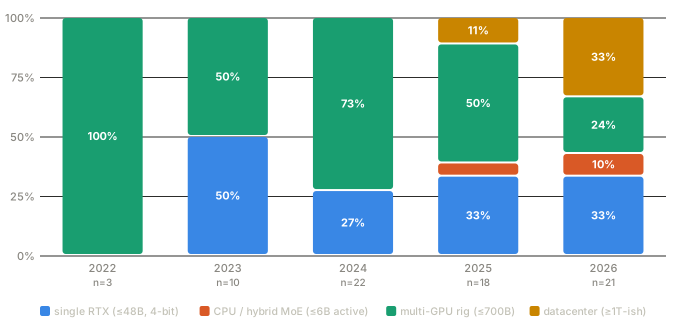
2026 is a barbell: a third of open releases fit on a single RTX card, a third are datacenter-only, and the multi-GPU middle collapsed from 73% (2024) to 24%. The local end has its own architecture now — the edge MoE, born this year: ~30B total with ~3B active. Qwen3.6-35B-A3B does 70–118 tok/s at 4-bit on an RTX 5090; Soofi S (31.6B/3.2B, hybrid Mamba-2) quantizes to ~18GB — that's a 24GB GPU or a CPU box with 32GB of RAM; DiffusionGemma 26B needs 16GB of VRAM; Gemma 4 31B and Ministral 3 round out the class. Three billion active parameters is little enough compute that CPU inference stops being a joke — the weights sit in ordinary RAM and the per-token work is what a laptop can do.
Between the poles, an enthusiast middle exists but it's thin: 1.8–2-bit dynamic quants put Kimi K2.5 on a 512GB M3 Ultra Mac Studio at ~10+ tok/s, and an EPYC box with one 4090 and ~384GB of DRAM sustains ~14 tok/s on a 671B-class model by keeping hot experts on the GPU and the rest in RAM. That trick tops out around K2 scale. For K3, even aggressive quants land at 650GB–1TB — "past every consumer hardware ceiling, including a 512GB Mac Studio".
What the internet is saying
The online discussion splits cleanly along that same barbell:
- The celebration: the trillion wave is real, mostly Chinese, and closing on the US frontier despite compute limits — VentureBeat on K3, Latent Space on Inkling ("the best American Apache 2.0 open model").
- The criticism has a name: "open weights you can't run" — open in license, unrunnable in practice. Qwen3.8's preview-before-weights drew the sharpest line: "the rare launch where the product is confirmed real and every single performance claim about it is unconfirmed".
- Where local energy actually is: the small sparse MoEs. Soofi S went modestly viral for its throughput; the r/LocalLLaMA-consensus picks for a 4090/5090 are Qwen3.6-35B-A3B, Gemma 4, and Ministral 3 — not anything with a T in its name. (Meanwhile the ecosystem argues about whether Ollama is drifting too far from llama.cpp.)
- The counterweights: UK AISI measures open models trailing frontier cyber capability by only 4–7 months, which keeps the safety debate hot (TechCrunch: "OpenAI is scared of open-weight models. Should the US be?"); critics flag "open-washing" (weights without data or code), tightening licenses, and Meta's quiet exit from open weights with Muse Spark.
Predictions
- Trillion-total becomes the standard open flagship tier by mid-2027. Zero → two → five per half-year, K3's full weights land July 27, Qwen3.8's open release is promised.
- ~5T open frontier in early 2028, active still under ~100B. The binding constraint becomes memory to hold weights, not compute to run them — which entrenches the weights-free/API-paid model, because self-hosting the flagship stays out of reach for almost everyone.
- The barbell widens. Expect every major lab to ship the pair: a trillion-scale flagship for the API and a ~30B/3B-active edge MoE for the community. The 100–700B middle keeps thinning — it's too big for a GPU and too small to be the best.
- CPU inference goes mainstream for the edge class. At ~3B active, the bottleneck is RAM capacity, not FLOPs. A 32GB laptop runs a 30B-class MoE today; DDR6 and NPU offload make that boring by 2027.
- The parity gap closes from below, not above. Open models already win on agentic/coding volume; closed labs keep the reasoning crown (Opus, GPT-5.x Pro, Gemini Deep Think). That split — open workhorses, closed frontier reasoning — survives 2027.
The honest caveats: nine frontier points is a small sample for a fit; nine of 102 open releases have undisclosed sizes (all product launches); the 4-bit memory rule is a rule of thumb that ignores context/KV-cache overhead; and the whole extrapolation assumes compute supply — export controls, ASIC availability — doesn't bend the curve. LongCat-2.0 trained on 50k Huawei Ascends precisely because that assumption is fragile.
Method: open-weight releases from the arcade dataset (102 after the audit additions), parameter counts collected per model (93 resolved; sizes now stored in the dataset), frontier fit by log-linear least squares on running-max points, hardware classes at Q4_K_M-style 4-bit quantization. Online-sentiment survey as of July 21, 2026 — key sources linked inline.