
Meta AI has published six research papers by mathematicians who worked with Muse Spark, five of them answering previously open questions, per Meta's research post and an announcement thread on October 2. They used Muse Spark 1.1 and 1.2 in Thinking Mode through the ordinary meta.ai chat, with no custom scaffold. The papers span probability, differential equations, group theory, optimization, arithmetic physics and non-associative algebra; the arithmetic-physics paper establishes a connection between number theory and string theory rather than answering a posed question.
How the work was done
Meta set four principles. A team of mathematicians guided each project and worked with Muse Spark to develop arguments. A second group then reviewed it. Each paper marks which passages were drafted by researchers and which by the AI. And each credits the earlier work it builds on.
Meta says the aim was to empower researchers, not mass-produce papers. Afterward it learned outside teams had independently announced solutions to some of the same problems; the papers acknowledge that work.
The six papers
Probability. In "The Strict Threshold for Gaussian Ellipsoid Fitting," Aykut Arslan worked with Muse Spark on how many random Gaussian points in high dimension an ellipsoid centered at a fixed point can fit. The paper proves a sharp threshold at about n ≈ d²/4 points: below it an ellipsoid exists with high probability, above it almost certainly none does. Behavior exactly at the threshold is unresolved. Proof strategies were developed with Muse Spark under Arslan's guidance and checked by four reviewers, Babak Modami, Alexander Roitershtein, Mark Sepanski and Grigory Sokolov.
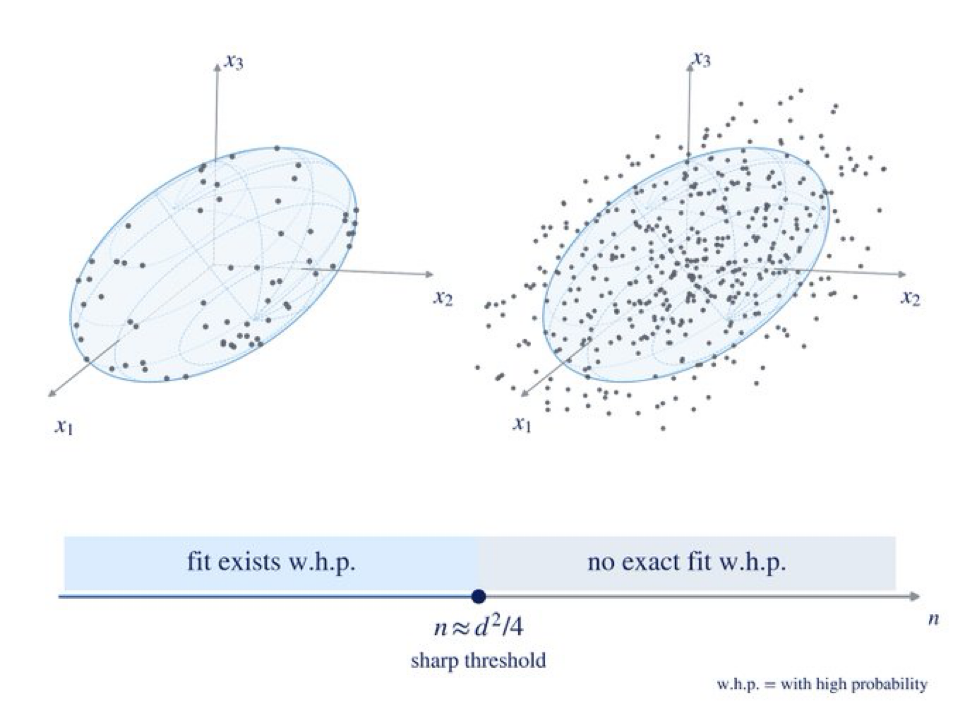
Figure 1 from Meta's research post.
Differential equations. Leonard Dinh's "Finite-Time Blow-Up of Radial Negative-Energy Solutions for the Mass-Critical Biharmonic Nonlinear Schrödinger Equation" concerns wave collapse in a laser-inspired model. For radially symmetric waves with negative energy in two or more dimensions, it proves collapse must occur in finite time. That settles a question left open in 2015, which a 2023 arXiv paper still described as open, and confirms a 2002 simulation-based prediction. Dinh chose the problem and key ideas; Muse Spark helped with calculations and revising the proof. Fazel Hadadifard and Salem Selim reviewed it.
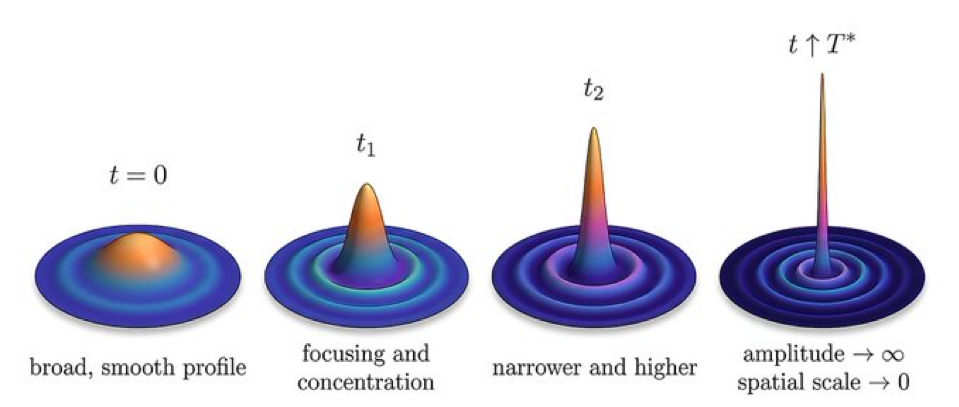
Figure 2 from Meta's research post.
Group theory. "Semiabelian Groups Need Not Be Monomial," by Joseph Phillip Brennan and Milana Golich, disproves a 2024 conjecture of M. Kida that every finite semiabelian group is monomial. The counterexample has 384 elements (SmallGroup(384, 20127)). Muse Spark wrote the GAP search program that found it; Golich and collaborators verified it, and Andres Barei and John Portin reviewed. Meta also credits the AI agent Nilradical, which reported a different counterexample on September 16.
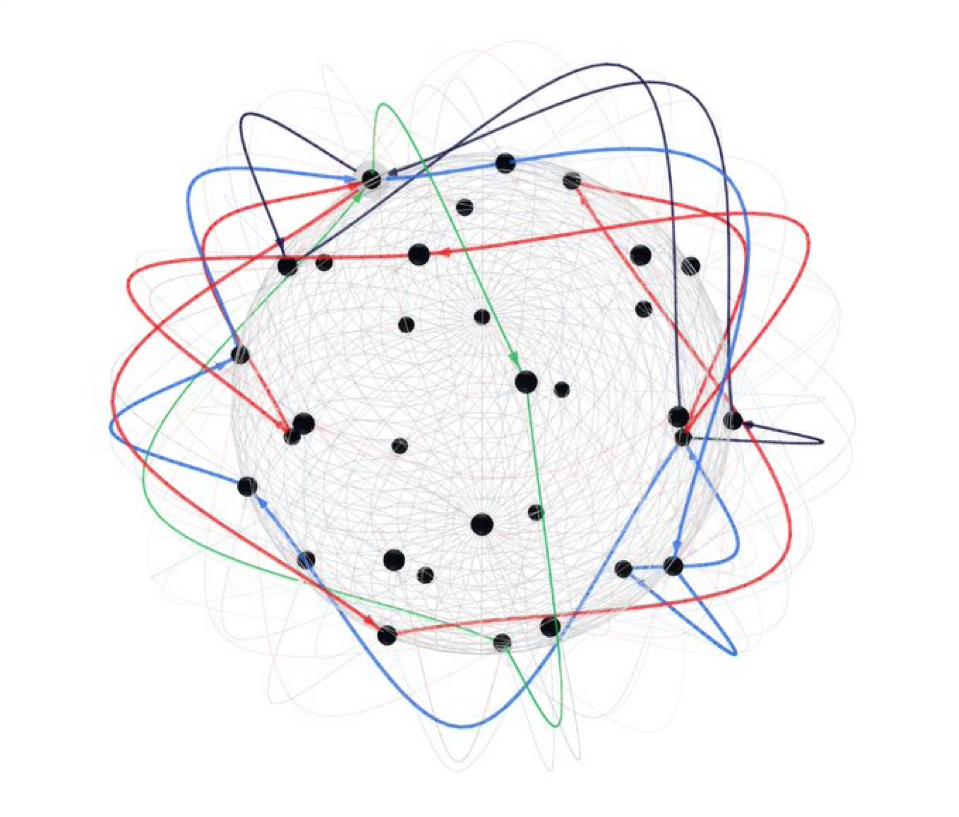
Figure 3 from Meta's research post.
Optimization. Arslan's second paper, "Tightness of the Cycle-Based Relaxation for Completed Length-Three Alpha-Cycles," answers a question Del Pia and Khajavirad posed in 2026 about when a relaxation of a binary polynomial optimization problem is exact. For the family studied, the relaxation is exact when each region shared by exactly two of three overlapping groups of decisions holds a single decision, and leaves a gap otherwise. Muse Spark helped reframe the problem probabilistically, identify a counterexample and develop the proof strategy; Arslan and Kien Trung Le checked it.
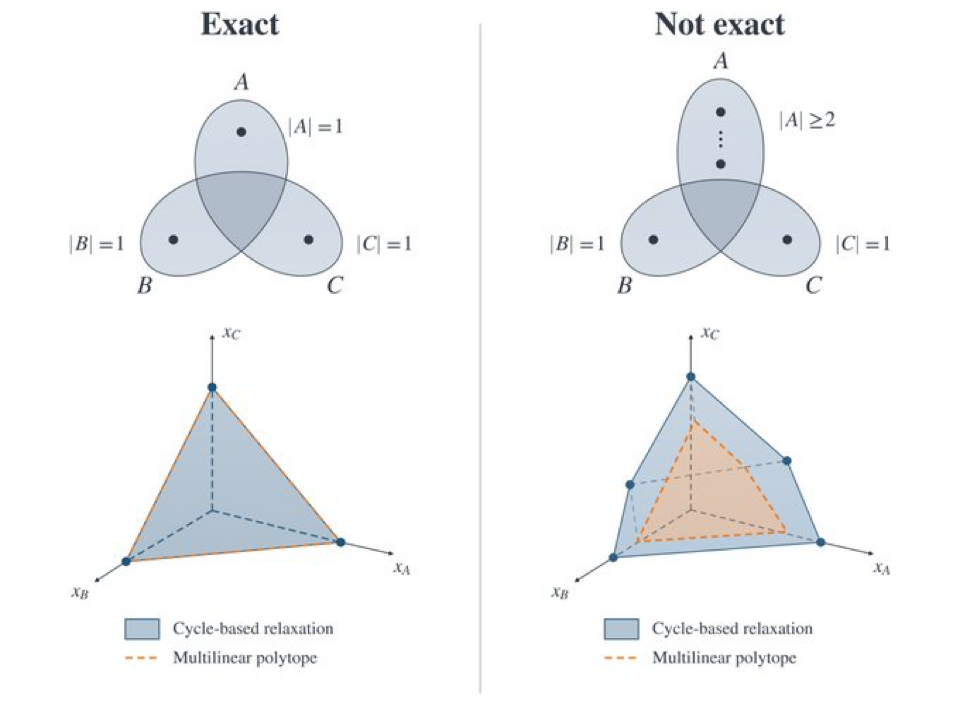
Figure 4 from Meta's research post.
Arithmetic physics. "String Two-Point Function = Height Function on a Curve," by Anindya Dey, Gabriel Herczeg, An Huang, Nicolas Jaramillo Torres and Jacob H. Swenberg, links number theory and p-adic string theory along a direction Yuri Manin envisioned in the 1980s. Starting from a known connection for the Tate curve, Muse Spark helped extend it to far more curves, showing two calculations in different mathematical languages describe the same quantity. Muse Spark generated candidate proofs and drafted three core technical sections, which researchers checked.
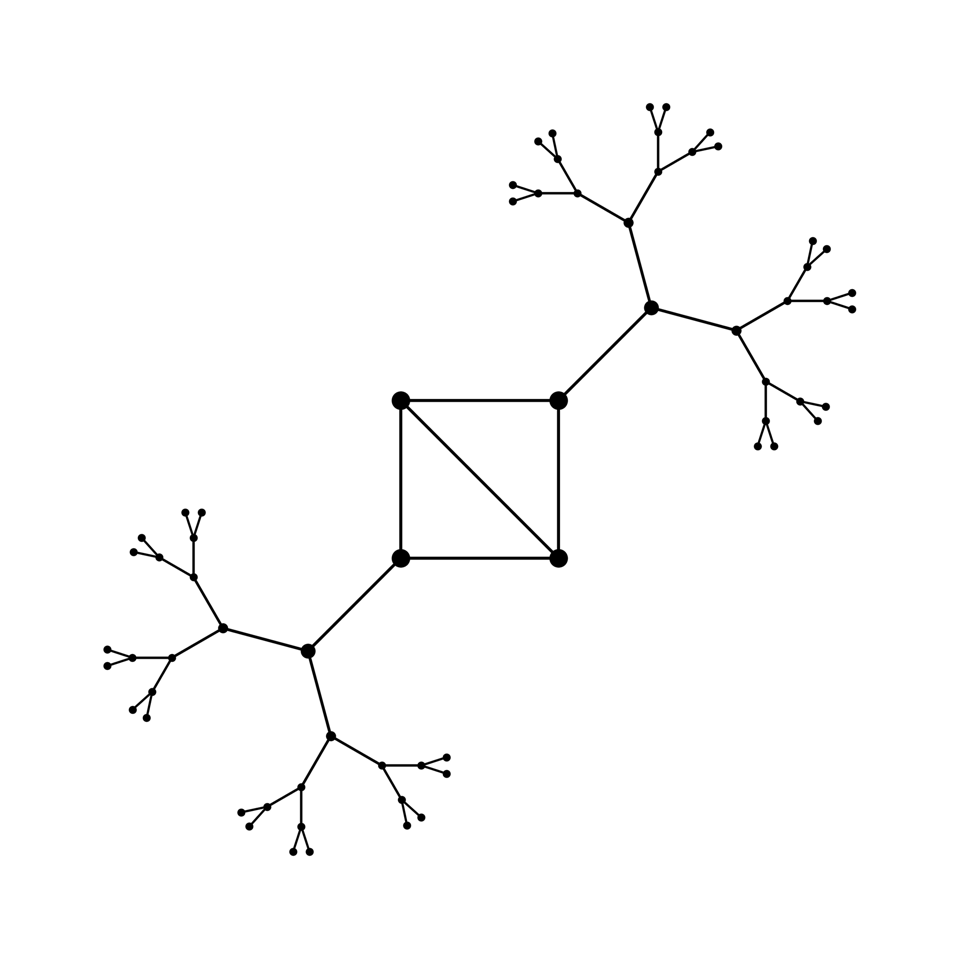
Figure 5 from Meta's research post.
Non-associative algebra. Andres Barei's "On Solvable Evolution Algebras and a Conjecture by García-Martínez and Pérez-Rodríguez" disproves a proposed test for classifying solvable evolution algebras, a conjecture from their note on complete evolution algebras (arXiv:2512.12418). Working from prompts, Muse Spark produced a small three-dimensional algebra that passes the test but is not solvable, and proposed alternative characterizations. The paper also establishes a replacement rule based on whole subspaces. Barei checked and rewrote it; Nicolás Jaramillo Torres reviewed.
Where it sits
The work used Muse Spark 1.1 (July 9) and 1.2 (August 5), not the current Muse Spark 1.3 from September 3. Meta frames it as a follow-on to Olympiad results: in early August it said an internal, unreleased Muse Spark-family model reached gold-medal level across the IMO, IChO and Romanian Masters, with perfect APhO and IPhO theory scores. Open research, unlike a contest, has no answer key. RuntimeWire describes an assistant contributing search code, proof approaches and drafted sections under expert direction, not a system choosing its own agenda; AlphaSignal headlined it "Five Open Research Problems."
OpenAI's ten advances in July leaned on a named mathematician vouching for the results, and the Navier-Stokes credit dispute showed how contested attribution can get. The Fields Medalists' declaration objected to rushed announcements and unattributed prior work. Meta names reviewers on five papers, labels AI-drafted passages and credits concurrent results.
Three papers acknowledge independent parallel work. On ellipsoids, Misiakiewicz and Wen proved the Gaussian threshold independently (arXiv:2608.10184, submitted August 10, building on Bandeira and Maillard, 2025). De la Cerda, Potechin, Tulsiani and Xu established it up to a vanishing multiplicative factor, and Koehler and Sohn obtained a broader universality result. Nilradical's counterexample is the parallel result for group theory, and Hu and Wen reported counterexamples to the evolution-algebra conjecture.
Meta says progress will require close expert-AI collaboration with carefully verified results.