
Z.ai released GLM-5.3-Flash — the first natively multimodal model in the GLM-5 series, 320B total parameters with 18B active, MIT-licensed — and confirmed something this blog had been tracking without a final answer: "Before release, we tested GLM-5.3-Flash anonymously as ox-alpha on OpenCode and OpenRouter to gather user feedback." That's a direct confirmation, from the lab itself, of what tokenizer-count fingerprinting and a malformed-request stack trace pointed at weeks ago. The free, anonymous "Ox Alpha" stealth model that became a guessing game across X was this model, tested under a pseudonym before its named launch. Worth closing that loop plainly rather than leaving it as a hedge: the identity question that post treated as an unconfirmed leading hypothesis is now settled.
What actually shipped
GLM-5.3-Flash introduces a hybrid attention architecture: sparse and linear attention combined, aimed specifically at cutting the cost of long-context serving while keeping long-context accuracy. It adds a technique Z.ai calls Manifold-Constrained Hyper-Connections (mHC) for scaling efficiency, and IndexPool, which compresses four indexer key vectors into one via weighted pooling to reduce the indexer's latency and memory overhead at up to 1M-token context. It's trained on a 30-trillion-token multimodal pretraining corpus and released under the MIT license — notably not Apache 2.0, which Z.ai's other recent GLM-5.x releases have used, worth flagging as a small but real difference in terms.
An independent teardown adds precision Z.ai's own post skips
Sebastian Raschka — an ML educator who maintains an "LLM Architecture Gallery" comparing how labs build their models — published an independent teardown naming the actual components behind Z.ai's generic "sparse and linear attention" description: 34 layers of Kimi Delta Attention (KDA, Moonshot/Kimi's own design) alongside 11 layers combining Multi-head Latent Attention and DeepSeek Sparse Attention (MLA/DSA, DeepSeek's own designs), in a 3:1 "super hybrid" ratio. That combination is unusual: Kimi and DeepSeek each pair their own efficient-attention variant with plain full attention, while GLM-5.3-Flash stacks two other labs' named designs together instead. He also attributes the "Manifold-Constrained Hyper-Connections" (mHC) residual mechanism to a DeepSeek V4-style four-stream design rather than a Z.ai original. And he supplies specs the vendor blog doesn't publish directly: 45 total layers, a 155k vocabulary, and only 18B of the 320B total parameters — 5.6% — active per token. Worth flagging plainly: this is one outside analyst's credible reconstruction, not Z.ai's own confirmed spec.
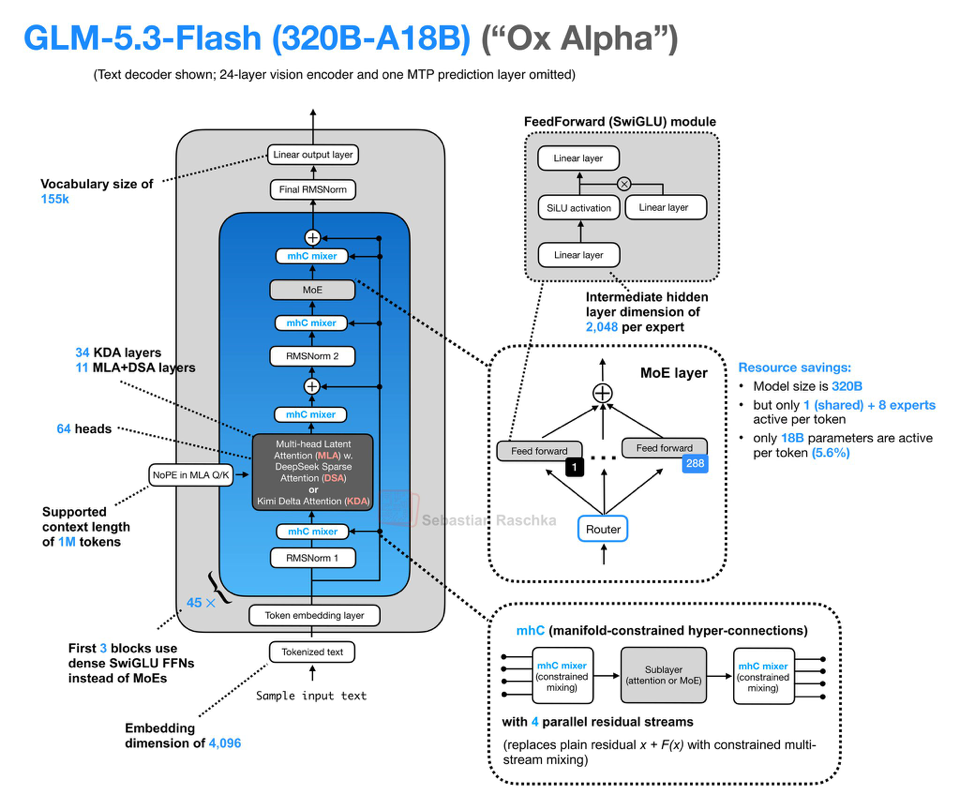 Independent architecture reconstruction by Sebastian Raschka, not an official Z.ai diagram.
The efficiency claim, and the one Z.ai disclosed against itself
Compared with the full-size GLM-5.3, Z.ai reports 3.0x lower attention compute and 4.4x smaller KV cache for GLM-5.3-Flash — a specific, checkable architectural claim. What's worth crediting directly is what Z.ai volunteers right alongside that number: GLM-5.3-Flash's KV cache is still larger than Kimi-K3's and DeepSeek-V4-Flash's, described in its own writeup as "leaving further room for improvement." That's a lab disclosing where its own architecture still trails competitors in the same breath as its headline efficiency win — worth naming as real transparency rather than a footnote to skip.
Separately, on the Artificial Analysis Intelligence Index v4.1.1 — an independently run benchmark aggregator, not a Z.ai construction — GLM-5.3-Flash scores 57 at $0.045 per task (discounted), which Z.ai frames as a level of intelligence "previously only available at roughly 10x the cost." That's a real third-party data point behind the cost-efficiency pitch, distinct from the vendor's own benchmark tables below.
The benchmark table, counted directly
Z.ai's own framing: GLM-5.3-Flash "outperforms GLM-5.2 across benchmarks and real-world workloads at one-tenth the price, while approaching Claude Opus 4.8 on coding and agentic benchmarks." Counting the published 14-row table directly, with the row winner in bold:
| Benchmark | GLM-5.3-Flash | GLM-5.2 | DeepSeek-V4-Vision-Exp | Opus 4.8 | GPT-5.6 Terra | Gemini 3.7 Flash |
|---|---|---|---|---|---|---|
| Terminal Bench 2.1 | 84.3 | 81.0 | 83.9 | 85.0 | 87.4 | 85.8 |
| DeepSWE v1.1 | 63.4 | 46.2 | 59.3 | 58.0 | 69.6 | 65.3 |
| NL2Repo | 56.3 | 48.9 | 57.7 | 69.7 | – | – |
| Toolathlon Verified | 78.4 | 59.9 | 75.9 | 76.2 | 74.9 | – |
| AutomationBench v1.0.6 | 48.8 | 26.2 | 38.8 | 41.0 | 37.2 | 52.3 |
| Agents' Last Exam | 26.3 | 20.4 | 27.3 | 27.0 | 28.0 | – |
| HLE w/ Tools | 55.3 | 54.7 | 55.1 | 57.9 | – | – |
| GDPval-AA v2 | 1773 | 1504 | 1675 | 1582 | 1571 | 1527 |
| OfficeQA Pro | 62.4 | – | 57.9 | 48.9 | – | – |
| CharXiv Reasoning w/ Tools | 89.4 | – | 80.4 | 89.9 | 88.0 | 88.7 |
| Chartography w/ Tools | 78.0 | – | 64.3 | 75.0 | 68.0 | 65.0 |
| BabyVision | 53.4 | – | 35.1 | 46.8 | 61.6 | 70.9 |
| MVbench | 77.8 | – | 69.4 | 67.1 | 75.0 | 82.2 |
| MMVU | 80.5 | – | 72.7 | 67.4 | 75.8 | 82.3 |
The first half of Z.ai's claim holds fully: GLM-5.3-Flash beats GLM-5.2 on every row where GLM-5.2 has a reported score, several by wide margins (DeepSWE v1.1: 63.4 vs. 46.2; AutomationBench: 48.8 vs. 26.2). The second half is where the table complicates the headline. GLM-5.3-Flash wins outright on 4 of 14 rows; Opus 4.8 wins 3. But two models Z.ai's text doesn't foreground actually win more rows than either half of that pairing: GPT-5.6 Terra wins 3 (Terminal Bench 2.1, DeepSWE v1.1, Agents' Last Exam), and Gemini 3.7 Flash wins 4 (AutomationBench, BabyVision, MVbench, MMVU) — as many outright wins as GLM-5.3-Flash itself, and more than Opus 4.8. "Approaching Claude Opus 4.8" is true and defensible about that specific pairwise gap, but it's not the same claim as leading the table — which two other models arguably do, by this same count.
Base model: competitive against a much larger sibling
Z.ai also published a base-model comparison: GLM-5.3-Flash-Base (18B active, 320B total) against GLM-4.5-Base, GLM-5-Base (40B active, 744B total — more than double the active parameters), and DeepSeek-V4-Flash-Base. GLM-5.3-Flash-Base beats GLM-4.5-Base overall and stays competitive with the much larger GLM-5-Base across most of the five reported benchmarks, trailing only narrowly on a couple. Worth flagging the DeepSeek comparison specifically: Z.ai's own footnote states DeepSeek-V4-Flash-Base was "evaluated using our internal evaluation framework to control for implementation differences" — a specific, disclosed methodology choice, but still Z.ai's own cross-lab comparison rather than a number DeepSeek published itself.
Chinese chips, and a model helping optimize its own serving stack
Z.ai says GLM-5.3-Flash has been served for a week on a large cluster of domestically developed AI chips, with a purpose-built inference engine on top of SGLang. It adds that a GLM-5.3-powered infrastructure agent assisted engineers in developing and optimizing kernels, diagnosing performance bottlenecks, and improving the serving stack — a model helping build the system that serves itself. That's the same AI-assisted low-level kernel optimization pattern this blog covered in NVIDIA's AVO evolving attention kernels and OpenAI's Jalapeño chip development this month; a third lab reporting the same kind of result independently is worth noting as a genuine trend rather than a one-off claim. Z.ai reports a 3x improvement in end-to-end serving performance over its own initial baseline on the same hardware, reaching efficiency "comparable to mainstream NVIDIA GPUs". That is a self-reported comparison against Z.ai's own prior baseline, not an independently verified benchmark against actual Nvidia hardware running the same workload.
What to expect next
- Watch for independent benchmarking against GPT-5.6 Terra and Gemini 3.7 Flash specifically, given the table itself shows those two, not just Opus 4.8, as the models GLM-5.3-Flash is genuinely trading wins with.
- Watch for third-party verification of the Chinese-chip serving efficiency claim. "Comparable to mainstream NVIDIA GPUs" is a specific, falsifiable claim about domestic accelerators that independent benchmarking could confirm or complicate.
- Watch whether other stealth-model mysteries get resolved this cleanly. Z.ai volunteering the Ox Alpha connection directly, rather than leaving it to community fingerprinting, is a notably different approach than most stealth-to-named transitions this year.