
Liquid AI released Open d1 on October 7, 2026: two open-weight models from its d1 decision family, with weights on Hugging Face. d1-3B takes text and vision, and d1-omni-600M takes text plus either an image or audio. Decision models return an answer in one forward pass rather than generating tokens. On the public split of Decision Index v0.2.1, d1-3B scores 48.57, ahead of every model under 10B and on par with Decider 35B-A3B, a decision model 12x its size. The experimental d1-omni-600M scores 15.95. Liquid's blog post positions the pair for everything from NVIDIA DGX in the data center to Jetson at the edge.
Decision models, not generators
Unlike Liquid's generative LFMs, d1 models output a decision: a yes/no answer with a probability, a choice among options with a confidence and per-criterion probabilities, or a score with a confidence. In the diagrams, a state plus an instruction template goes in, and a head reads the decision off the final layer.
d1-3B starts from LFM2.5-VL-3B. Liquid averaged the weights of LFM2.5-2.6B with that model's text backbone for a stronger base, fine-tuned checkpoints with different seeds and data mixtures, then merged them again. Training on long inputs, shuffling answer options and fixing shortcuts in the data mattered more than more advanced techniques.
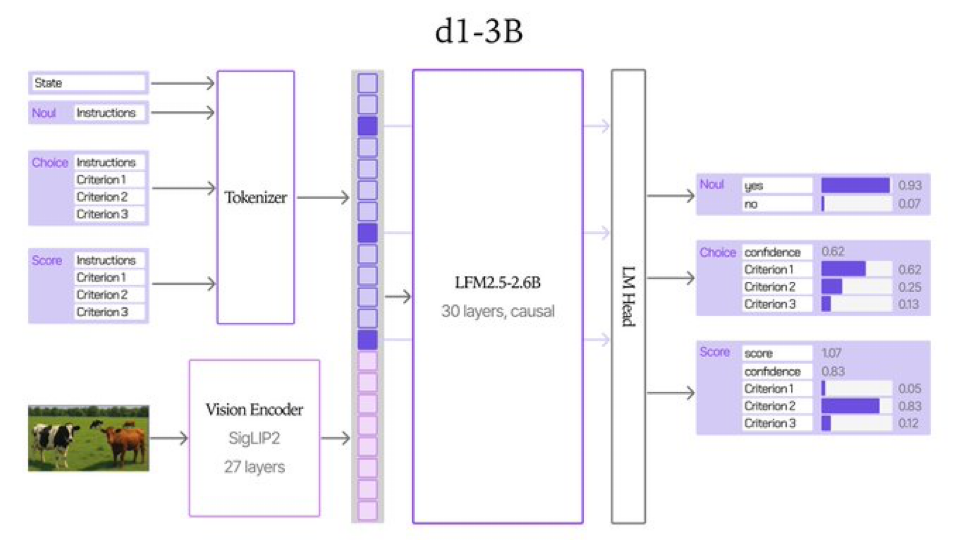 From Liquid AI's blog post.
d1-omni-600M is built on LFM2.5-Encoder-350M, a bidirectional encoder, with a SigLIP2 vision encoder or a FastConformer audio encoder attached. It was fine-tuned on decision tasks first, then audio and vision were added in stages: the audio encoder was tuned against a frozen text backbone, and the vision encoder from LFM2.5-VL-450M was added with an adapter and LoRA updates active only when images are present. A full fine-tune, a LoRA merge and weight averaging closed the process.
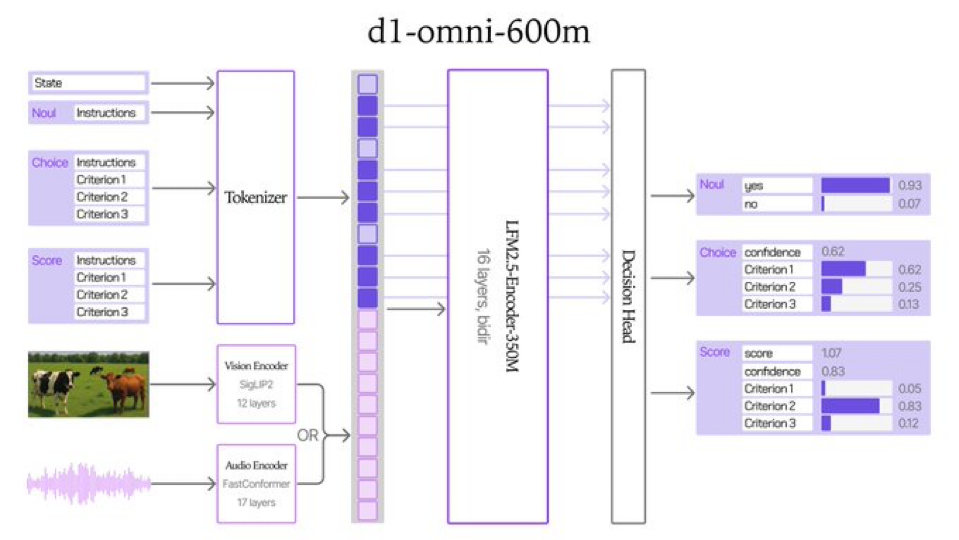 From Liquid AI's blog post.
Benchmarks
On the Decision Index chart, d1-3B sits at roughly 48.5 at 3B parameters, on the size-versus-score frontier, and d1-omni-600M at roughly 16 at 0.6B. Fine-tuned and inference-technique entrants up to 32B land between roughly 40 and 57, and two hosted APIs sit higher, d1 at roughly 60 and Jev 1.13 at roughly 57 to 58.
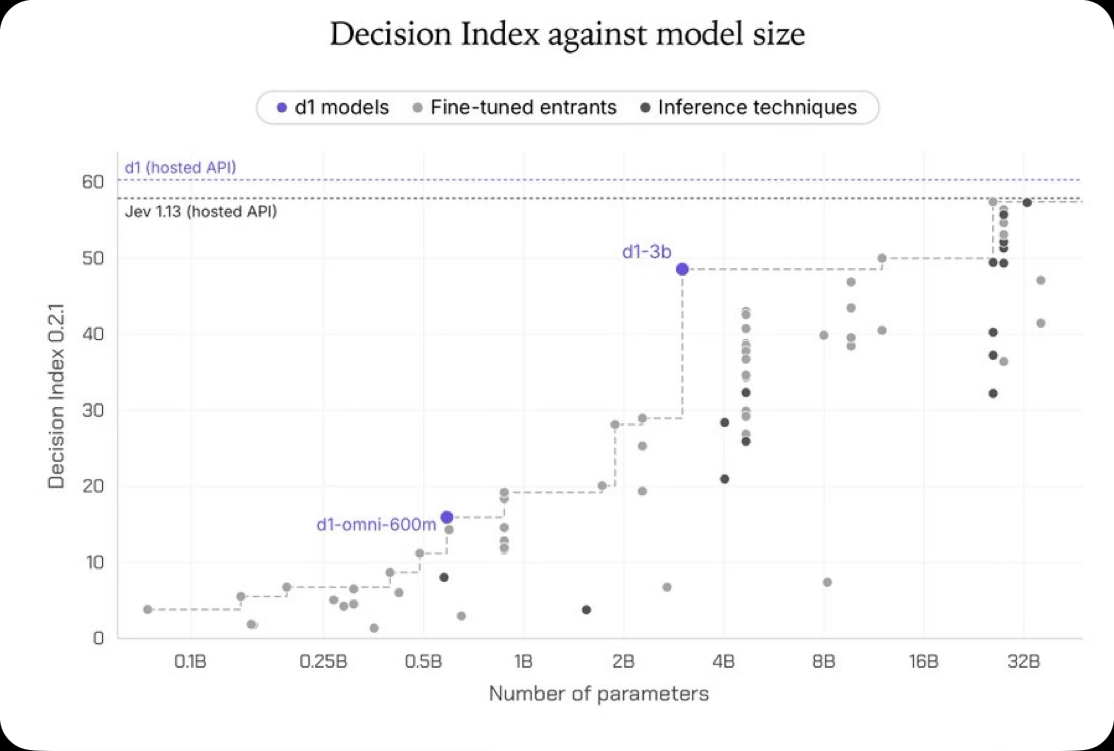 From Liquid AI's thread.
On seven public text benchmarks, d1-3B has the highest mean, 82.9 against 81.1 for Decider 4B. d1-omni-600M's 78.4 beats Decider 2B's 77.1 at 0.6B parameters, under a third of its size.
| Benchmark | d1-omni-600M | d1-3B | Decider 2B | Decider 4B |
|---|---|---|---|---|
| SQuAD 2.0 | 74.0 | 85.3 | 67.7 | 76.0 |
| Civil Comments | 95.8 | 93.0 | 93.6 | 92.8 |
| MASSIVE intent | 86.1 | 87.3 | 81.1 | 88.3 |
| PubMedQA | 61.3 | 66.0 | 65.7 | 63.3 |
| BoolQ | 77.7 | 86.7 | 87.3 | 89.0 |
| XNLI | 74.7 | 85.0 | 85.0 | 88.6 |
| PAWS-X | 79.5 | 76.9 | 59.5 | 69.8 |
| Mean | 78.4 | 82.9 | 77.1 | 81.1 |
The means recompute exactly, but the mean hides the row picture. d1-3B tops only two rows, SQuAD 2.0 and PubMedQA; Decider 4B wins MASSIVE, BoolQ (89.0 against 86.7) and XNLI (88.6 against 85.0), and d1-3B only ties Decider 2B on XNLI at 85.0. The small omni model takes the other two, Civil Comments (toxicity) and PAWS-X (paraphrase).
Decision Index v0.3 has a private vision split that is not reported; Liquid validated that d1-3B keeps LFM2.5-VL-3B's vision capabilities on standard benchmarks and that d1-omni-600M handles all three modalities in its playground demos. Dedicated audio decision benchmarks do not exist yet, and Liquid hopes the community builds them.
Fast on edge hardware
Because nothing is generated, latency is end-to-end. Liquid's d1-3B figures, one request at a time (edge devices measured with NVIDIA):
| Device | 1 question | 3 questions | 3.4K-token state | 384px image | 64 states packed |
|---|---|---|---|---|---|
| RTX 4090 | 8 ms | 21 ms | 102 ms | 17 ms | 475/s |
| AMD MI325X | 9 ms | 14 ms | 44 ms | 18 ms | 1,106/s |
| Jetson AGX Thor | 16 ms | 20 ms | 220 ms | 35 ms | 262/s |
| Jetson AGX Orin 64GB | 26 ms | 35 ms | 560 ms | 83 ms | 110/s |
| Apple M5 Pro | 30 ms | 41 ms | 640 ms | 62 ms | 78/s |
| Jetson Orin Nano | 50 ms | 73 ms | 1,640 ms | 202 ms | 38/s |
A single question stays at or under 50 ms on every device, and under 10 ms on both GPUs. Three questions cost about 1.3x one question on the edge devices (Thor goes from 16 to 20 ms, a 1.25x ratio); the RTX 4090 pays about 2.6x. llama.cpp support with NVFP4 shipped on day one across Apple, AMD, Qualcomm and NVIDIA. Numbers are for d1-3B only, as d1-omni-600M is an early research release.
What you can build
Liquid published ten demos in a Hugging Face space, with no setup, that run d1-3B in a loop over live camera input, one pass per frame. They range from gesture-controlled games to live content moderation. With NVIDIA, Liquid also showed d1-3B navigating an environment in Isaac Sim, served from a Jetson in a hardware-in-the-loop setup.
Context
d1-3B builds on LFM2.5-VL-3B, Liquid's vision-language model, and on the weights of LFM2.5-2.6B, the small model Liquid pitched for local agents. NVIDIA's own small specialist worker is covered in Nemotron 3.5 Lightning, and EmbeddingGemma 2 is another multimodal model sized for on-device use.