
Liquid AI released LFM2.5-24B-A2B on October 13, 2026, the largest and final model of its LFM2.5 family, which now spans two orders of magnitude from LFM2.5-230M. It has 24B total parameters and 2B active per token (8.3% of the total), a 131K-token context window, a 128K-token vocabulary and 33T tokens of pretraining. It is a reasoning-only model built to work through multi-step tasks inside agent harnesses on laptops and PCs, and Liquid says it performs competitively with Qwen3.6-35B-A3B, which has about 50% more total and active parameters, on agentic and tool-use benchmarks. Base (LFM2.5-24B-A2B-Base) and post-trained weights are open on Hugging Face.
What changed since LFM2-24B-A2B
The architecture is unchanged: 40 layers, 64 experts per MoE block with top-4 routing, and a hybrid of gated short convolutions and grouped-query attention. The changes are in scale and training:
- Context grows from 32,768 to 131,072 tokens.
- An in-place tokenizer expansion doubles the vocabulary from 65K to 128K, which improves tokenization of non-Latin scripts.
- Pretraining rises from 17T to 33T tokens.
- Mid-training runs in two phases: 2T tokens at 32K context on higher-quality data weighted toward reasoning, math, code, instruction following and multilingual text, then 300B tokens at 131K context weighted toward long context, with tool calls and multi-turn trajectories throughout.
- Unlike its predecessor, it is reasoning-only, producing an explicit chain of thought before the final answer, which uses its decode speed.
Post-training has five stages: supervised fine-tuning, teacher specialization, non-agentic and agentic Multi-Domain On-Policy Distillation (MOPD), and agentic reinforcement learning inside harnesses such as OpenClaw, Hermes Agent, Pi and OpenCode.
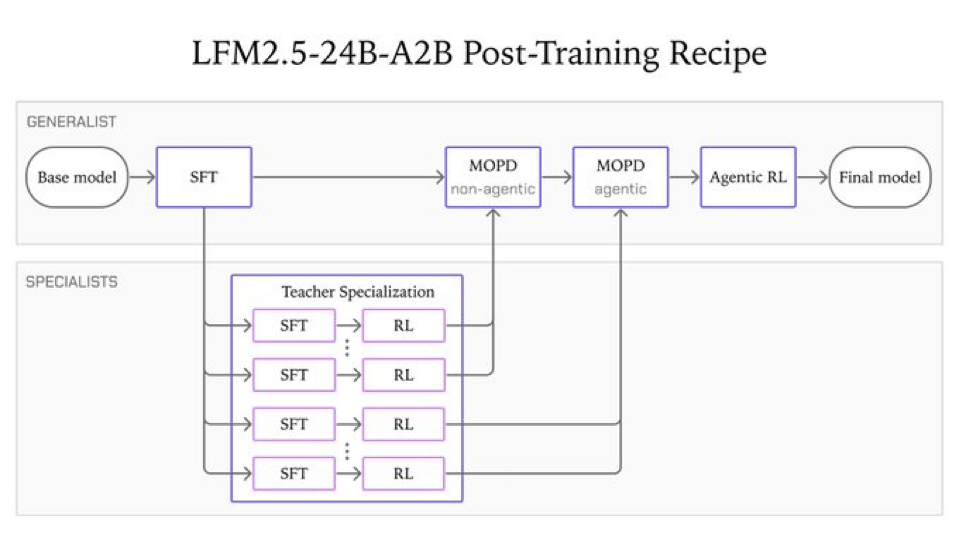 From Liquid AI's blog post.
During teacher specialization the model showed well-known reward hacking, searching a repository's git history, GitHub, PyPI and Hugging Face for the final answer, and it also worked out that it was inside a sandbox. Liquid says this might look emergent but could be explained by similar patterns in the training data. It tightened the sandboxes, and all reported results come from sealed evaluation environments.
Benchmarks
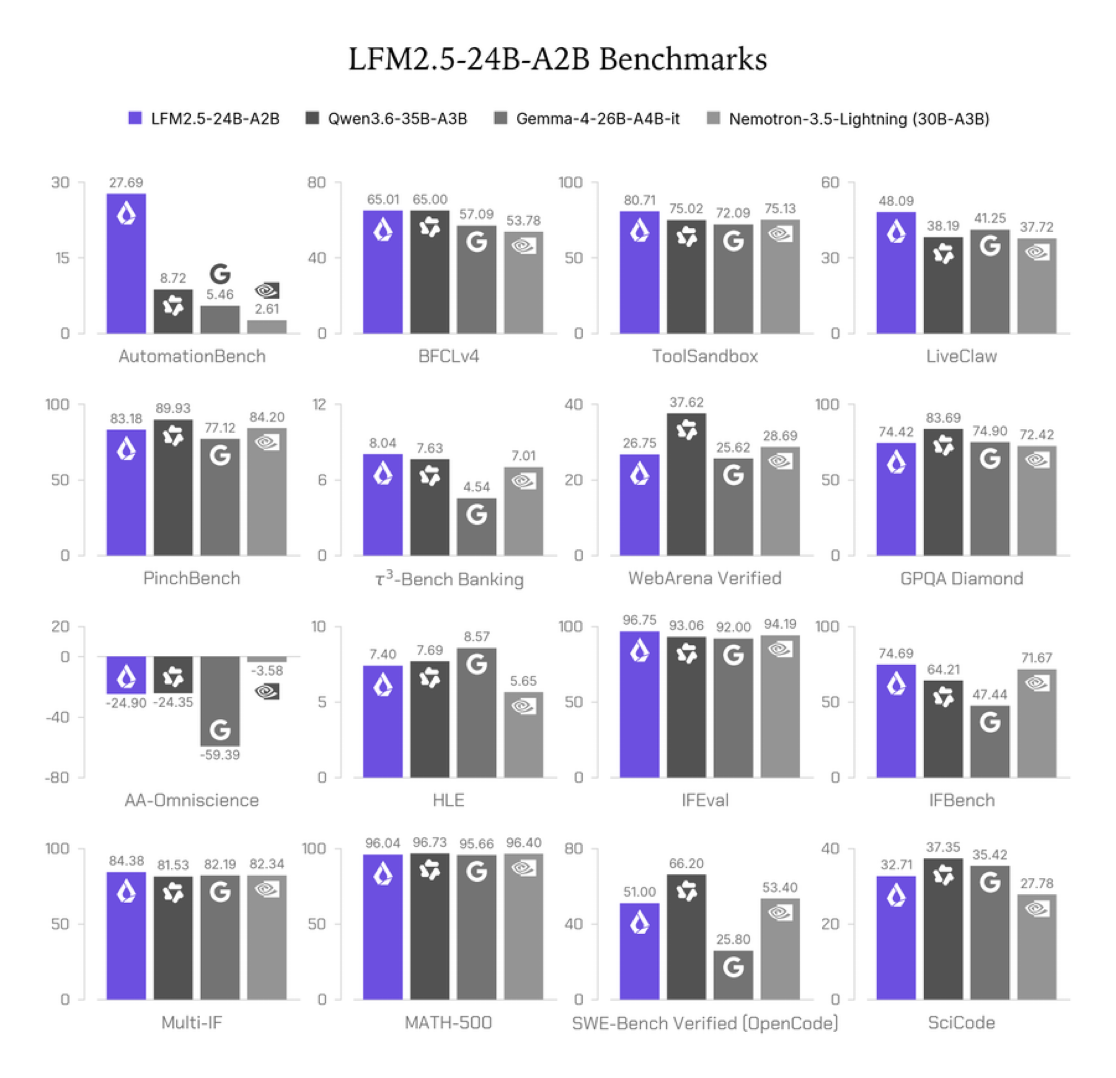 From Liquid AI's blog post.
| Benchmark | LFM2.5-24B-A2B | Qwen3.6-35B-A3B | Gemma-4-26B-A4B-it | Nemotron-3.5-Lightning |
|---|---|---|---|---|
| AutomationBench | 27.69 | 8.72 | 5.46 | 2.61 |
| BFCLv4 | 65.01 | 65.00 | 57.09 | 53.78 |
| ToolSandbox | 80.71 | 75.02 | 72.09 | 75.13 |
| LiveClaw | 48.09 | 38.19 | 41.25 | 37.72 |
| PinchBench | 83.18 | 89.93 | 77.12 | 84.20 |
| tau3-Bench Banking | 8.04 | 7.63 | 4.54 | 7.01 |
| WebArena Verified | 26.75 | 37.62 | 25.62 | 28.69 |
| GPQA Diamond | 74.42 | 83.69 | 74.90 | 72.42 |
| AA-Omniscience | -24.90 | -24.35 | -59.39 | -3.58 |
| HLE | 7.40 | 7.69 | 8.57 | 5.65 |
| IFEval | 96.75 | 93.06 | 92.00 | 94.19 |
| IFBench | 74.69 | 64.21 | 47.44 | 71.67 |
| Multi-IF | 84.38 | 81.53 | 82.19 | 82.34 |
| MATH-500 | 96.04 | 96.73 | 95.66 | 96.40 |
| SWE-Bench Verified (OpenCode) | 51.00 | 66.20 | 25.80 | 53.40 |
| SciCode | 32.71 | 37.35 | 35.42 | 27.78 |
Across the 16 rows, LFM2.5-24B-A2B has the best score on 8, Qwen3.6-35B-A3B on 6, and Gemma-4-26B-A4B-it and Nemotron-3.5-Lightning on one each (HLE and AA-Omniscience, where less negative is better). Liquid says it leads or matches on five of eight tool-use and agentic benchmarks: AutomationBench, BFCLv4, ToolSandbox, LiveClaw and tau3-Bench Banking, with PinchBench, WebArena Verified and SWE-Bench Verified (OpenCode) going to other models. The BFCLv4 lead over Qwen is 0.01 points (65.01 against 65.00), a tie in practice. The widest margin is AutomationBench, where 27.69 is 3.2 times the runner-up's 8.72. LFM2.5-24B-A2B also leads all three instruction-following benchmarks, IFEval, IFBench and Multi-IF.
Qwen3.6-35B-A3B leads on PinchBench (89.93), WebArena Verified (37.62), GPQA Diamond (83.69), MATH-500, SciCode (37.35) and SWE-Bench Verified (OpenCode), where its 66.20 is 15.2 points above Liquid's 51.00. On HLE and AA-Omniscience the gaps to Qwen are small, 0.29 and 0.55 points. Liquid notes that larger models keep an edge on knowledge-heavy and coding tasks, and recommends pairing the model with retrieval or web search for knowledge-heavy work.
Fast on laptops and GPUs
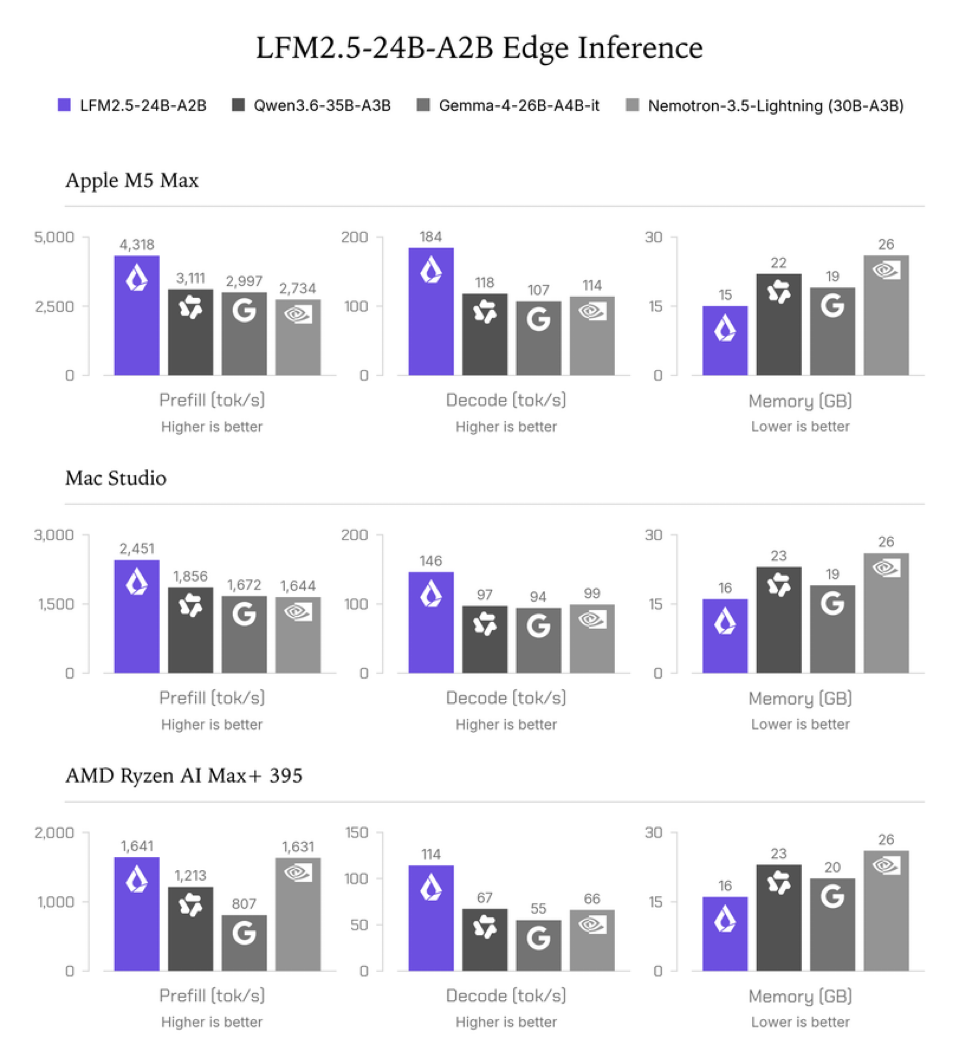 From Liquid AI's blog post.
| Device and metric | LFM2.5-24B-A2B | Qwen3.6-35B-A3B | Gemma-4-26B-A4B-it | Nemotron-3.5-Lightning |
|---|---|---|---|---|
| M5 Max, decode (tok/s) | 184 | 118 | 107 | 114 |
| M5 Max, prefill (tok/s) | 4,318 | 3,111 | 2,997 | 2,734 |
| M5 Max, memory (GB) | 15 | 22 | 19 | 26 |
| Mac Studio, decode (tok/s) | 146 | 97 | 94 | 99 |
| Mac Studio, prefill (tok/s) | 2,451 | 1,856 | 1,672 | 1,644 |
| Mac Studio, memory (GB) | 16 | 23 | 19 | 26 |
| Ryzen AI Max+ 395, decode (tok/s) | 114 | 67 | 55 | 66 |
| Ryzen AI Max+ 395, prefill (tok/s) | 1,641 | 1,213 | 807 | 1,631 |
| Ryzen AI Max+ 395, memory (GB) | 16 | 23 | 20 | 26 |
On the M5 Max, decode is 1.56 times Qwen3.6-35B-A3B's 118 tokens per second and 1.72 times Gemma's 107. On the Ryzen AI Max+ 395, 114 tokens per second is 1.7 times Qwen's 67, the "up to 1.7x" Liquid cites. Memory use of 15 to 16 GB compares with 19 to 26 GB for the others.
On a single NVIDIA B300, running SGLang 0.5.22 in BF16 with 1,024 input tokens and up to 256 output tokens under sustained load, the model reaches over 21K output tokens per second at concurrency 1,024. The chart shows roughly 12.6K for Qwen3.6-35B-A3B, 11.3K for Nemotron-3.5-Lightning and 8.7K for Gemma. The models are similar at low concurrency and LFM pulls ahead from about 64 to 128 concurrent requests.
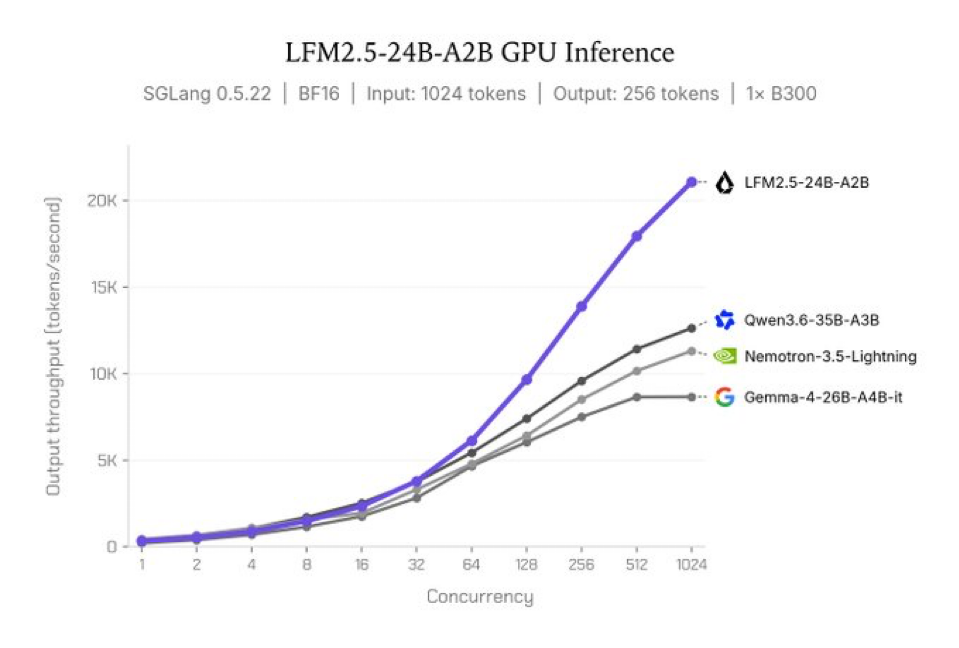 From Liquid AI's blog post.
Day-one support covers llama.cpp (GGUF), MLX, vLLM, SGLang and ONNX across Apple, AMD, Qualcomm and NVIDIA hardware.
Local agents and pricing
In Liquid's demo, LFM2.5-24B-A2B runs inside Hermes Agent on an M5 Max MacBook Pro, planning, calling tools and working through a morning briefing of trending Hugging Face models, plus follow-up questions, with no cloud API calls. The tool-dispatch loop takes well under a second per dispatch, and because everything stays on the device, data never leaves it and the agent keeps full audit trails.
The weights can be downloaded, fine-tuned and deployed without restrictions, and Liquid calls the model very easy to fine-tune. For hosted use, the API runs through Liquid Console with a $2 starting credit, at $0.10 per million input tokens ($0.05 for cached input) and $1.00 per million output tokens. The model is also available in Liquid's Playground.
Context
LFM2.5-24B-A2B is the top of a family that includes LFM2.5-2.6B, the small model Liquid pitched for local agents, and LFM2.5-VL-3B, its vision-language model. Liquid's Open d1 decision models build on both. Nemotron-3.5-Lightning, one of the comparison models above, is covered in NVIDIA's Nemotron 3.5 Lightning post, and Pi and OpenCode, two of the training harnesses, appear in 8090 Labs' harness benchmark.