
Reflection AI released Beam, its first open-weight model, with weights on Hugging Face under the Apache 2.0 license. Beam is a sparse Mixture-of-Experts with 501 billion total parameters and 23 billion active per token, about 4.6% of the total, built for advanced coding, reasoning and long-horizon agentic work with what Reflection calls frontier reasoning efficiency. It launches with more than 40 partners and the open-source harness it was trained on, Mirror CLI, which Reflection describes as "an open operating system for agents": "The model is the kernel, and everything above the infrastructure layer is open."
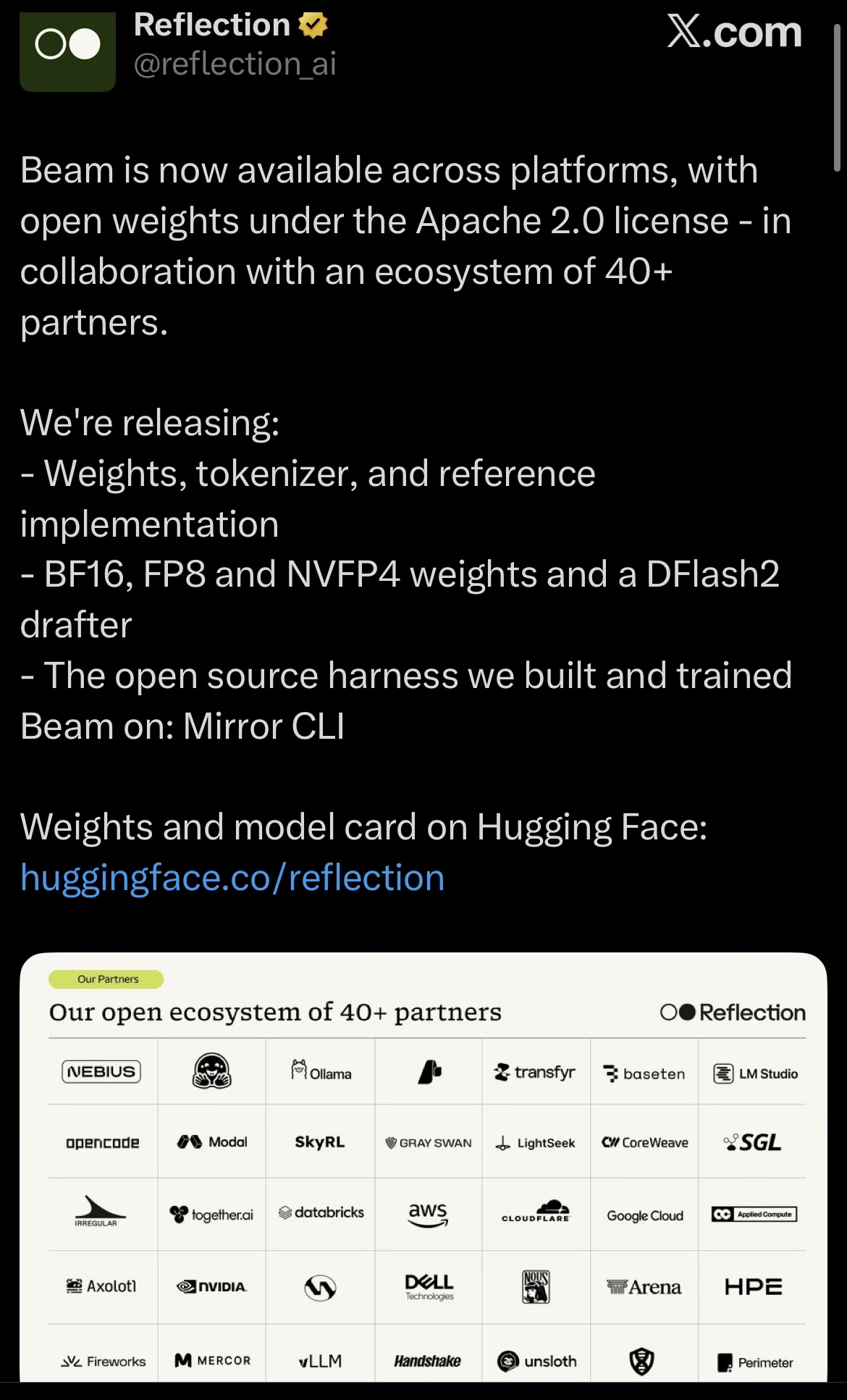 From Reflection's announcement.
What ships
Reflection is releasing the weights, the tokenizer and a reference implementation. The weights come in BF16, FP8 and NVFP4, alongside a speculative-decoding drafter (DFlash2). Partners tuned serving configurations and fused kernels for them.
The model card on Hugging Face carries the final benchmarks, and a separate Beam Safety Technical Report describes the safety methodology and evaluations. Day-zero support covers Transformers (Hugging Face), vLLM (Inferact), SGLang (RadixArk), Unsloth, Axolotl, TokenSpeed (LightSeek Foundation) and Dynamo (NVIDIA). Everything above the infrastructure layer is open, Reflection says: reference agentic integrations, deployment containers, inference integrations and customization pipelines.
Mirror CLI
Beam was trained together with Mirror CLI for best performance, and it is also integrated with other open harnesses: Reflection tested it with Pi (Earendil), OpenCode (Anomaly) and Hermes (Nous Research) across coding and knowledge work such as reading repositories, editing files and running commands.
Mirror runs Beam from a terminal, on any checkpoint or endpoint. Users can inspect activity, approve tool calls, steer, resume conversations, and run parallel agents in separate worktrees. It supports project instructions, skills, MCP and Python extensions. The architecture pairs a Python frontend for prompts, skills and developer tooling with a minimal Rust agent core that drives the model over a local connection, which also makes a clean evaluation surface.
Reflection built Mirror for internal use first, with isolated workspaces, background sessions and Slack, Linear and GitHub integrations; agents kept working after laptops closed, with the biggest gains in code review. Those lessons helped train Beam to work across harnesses before Mirror was open-sourced. Harness choice matters: 8090 Labs' DeepSWE study, which included Pi and OpenCode, found one model scoring 24% or 59% depending on the harness.
Training and customization
Across training, evaluation and ablations, Reflection's largest RL runs used roughly 1.3 billion sandboxes. In the peak hour of the final RL run, the fleet reached 883,006 vCPUs across 23 clusters on GCP and AWS, 83% of allocatable capacity (implying about 1.06 million allocatable vCPUs). Lessons were upstreamed, including OpenEnv, an open environment standard Reflection will adopt for future runs.
For post-training, Reflection partnered with NVIDIA (NeMo RL, AutoModel, Megatron), RadixArk (Miles), Hugging Face (TRL), Anyscale (SkyRL) and Axolotl. It also describes a Beam Self-Distillation loop: generate traces on your own tasks, train a LoRA adapter on the verified traces, and repeat. Recipes are promised in the coming days.
Early use cases
Three early creators built with Beam:
- Lorenzo Balderrama Porras (CoreWeave) made an escape room where Beam repairs a planetary machine, routes light through mirrors and plans a robot's escape. Beam gets rules and state through tools and runs Python in CoreWeave Sandbox.
- Wesche (@WescheNex1q), using Hermes through the Nous Portal, gave four models the same task, a voxel pagoda garden on one HTML page. Beam, under the codename MissingNo, produced the pagoda, cherry trees and pine in 117 seconds using 12.6K tokens with a one-line fix.
- Adam Roman (@adamisnotroman), using OpenCode, had Beam (codename Catjam) and Big Pickle build a mobile browser Snake game from the same prompt. Reported build times were 2:19.7 for Beam and 4:56.4 for Big Pickle, 139.7 seconds against 296.4, so Beam finished about 2.1 times faster.
Where to get it
At launch Beam is available on Amazon Web Services, Microsoft Azure, Google Cloud, Oracle, Nebius, CoreWeave, Databricks, Cloudflare, Vercel, Modal, Baseten, Fireworks AI, Together AI, OpenRouter, NVIDIA NIMs, Ollama, LM Studio, OpenCode and Hermes, among others. For on-premises, sovereign and air-gapped deployments, Dell and HPE deliver Beam behind the firewall.
Reflection's first-party API is in free public beta at platform.reflection.ai, with docs at developers.reflection.ai. Safety and evaluation testers thanked by Reflection include Andon Labs, Artificial Analysis, Arena, Gray Swan, Irregular, SecureBio and Snorkel AI.
Context
Beam arrives amid a run of large open-weight releases. NVIDIA released the 120B-parameter, 12B-active Nemotron 3.5 Super VL a day earlier, and Moonshot's 2.8-trillion-parameter Kimi K3 set the size record in July, part of the heavyweight shift. Reflection AI was also among the labs named as inaugural partners of NVIDIA's Open Secure AI Alliance.