
Richard Socher announced Flint, Recursive's first model: a fast local coding model built with the company's automated research system, the Eureka Machine. Open weights are on Hugging Face, and it can be run locally or tried for free on opencode and Pi. Socher's pitch is "private, unmetered intelligence on your own machine," built from scratch in under four months. Coverage reports an Apache 2.0 license and support for Ollama, LM Studio and llama.cpp.
What Flint is
Flint has 40B total parameters with about 2B active per token. Recursive says its Eureka Machine contributed to the training recipe, the architecture and chip-specific software, with researchers mostly watching and picking winners. Recursive compares it with sparse mixture-of-experts models of 33 to 35B total and 3B active (Qwen 3.5, Qwen 3.6, Laguna XS 2.1) and with dense models of 27 to 31B (Qwen 3.8, Muse Glimmer, Gemma 4), all able to run on similar hardware.
Speed
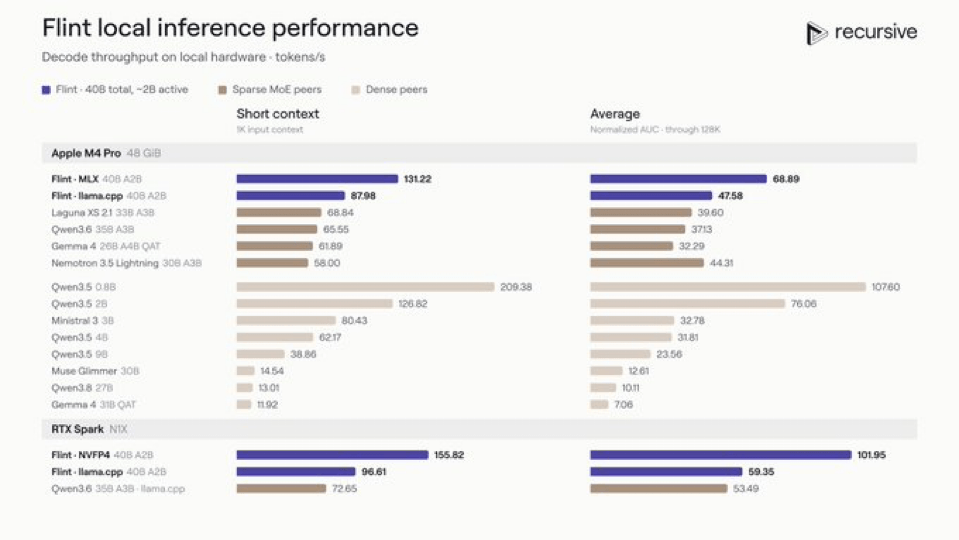 Local decode throughput in tokens/s, from Recursive's announcement.
On an Apple M4 Pro with 48 GiB, Flint runs at 131 tokens/s in MLX and 88 in llama.cpp on short context, against 65.6 for Qwen 3.6 35B A3B, 68.8 for Laguna XS 2.1 and 61.9 for Gemma 4 26B QAT. Averaged through a 128K session, it holds 68.9 (MLX) and 47.6 (llama.cpp) against 37.1 for Qwen 3.6 and 44.3 for Nemotron 3.5 Lightning. On RTX Spark hardware it reaches 156 tokens/s with NVFP4 and 96.6 with llama.cpp, against 72.7 for Qwen 3.6.
The "up to 2x faster" claim holds on the best Flint build: 131.2 against 65.6 is 2.0x, and the 128K average gives 1.86x. Against Qwen 3.6 on the same llama.cpp framework on RTX Spark, the lead is 1.33x on short context and 1.11x on the long-context average. The dense models are far slower (Qwen 3.8 27B at 13 tokens/s, Muse Glimmer 30B at 14.5).
Quality
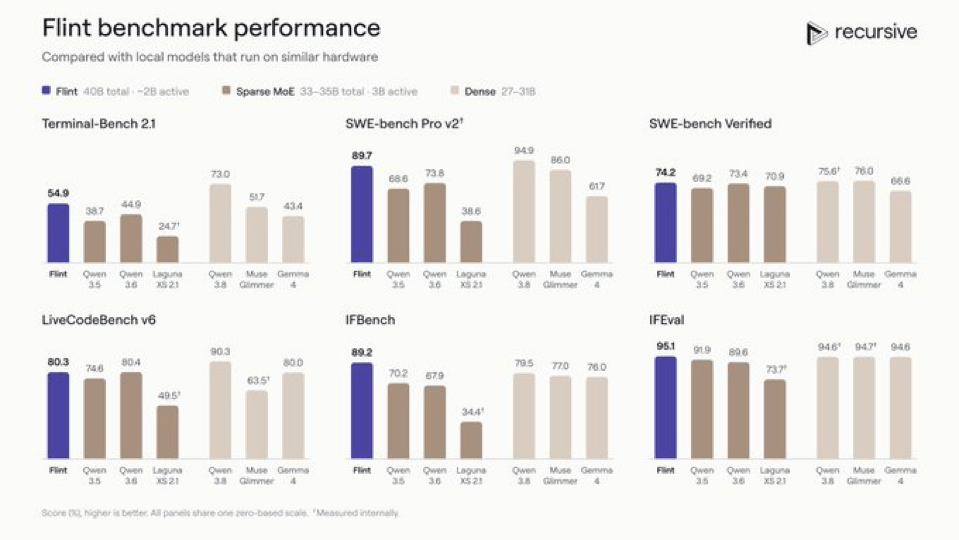 Benchmark scores (%), from Recursive's announcement. Daggers mark scores measured internally.
| Benchmark | Flint | Qwen 3.6 | Muse Glimmer | Qwen 3.8 | Gemma 4 |
|---|---|---|---|---|---|
| Terminal-Bench 2.1 | 54.9 | 44.9 | 51.7 | 73.0 | 43.4 |
| SWE-bench Pro v2 | 89.7 | 73.8 | 86.0 | 94.9 | 61.7 |
| SWE-bench Verified | 74.2 | 73.4 | 76.0 | 75.6 | 66.6 |
| LiveCodeBench v6 | 80.3 | 80.4 | 63.5 | 90.3 | 80.0 |
| IFBench | 89.2 | 67.9 | 77.0 | 79.5 | 76.0 |
| IFEval | 95.1 | 89.6 | 94.7 | 94.6 | 94.6 |
Averaging the six rows gives about 80.6 for Flint, against 71.7 for Qwen 3.6, 74.8 for Muse Glimmer and 84.7 for dense Qwen 3.8 27B. Flint beats every sparse peer on all six benchmarks except LiveCodeBench (80.3 vs 80.4 for Qwen 3.6), and beats Muse Glimmer on five of six. Qwen 3.8 leads on four, but runs at about 10 tokens/s on average here against Flint's 48 to 69. The comparison is on SWE-bench Pro v2, a different version from the SWE-Bench Pro scores in the Glimmer post.
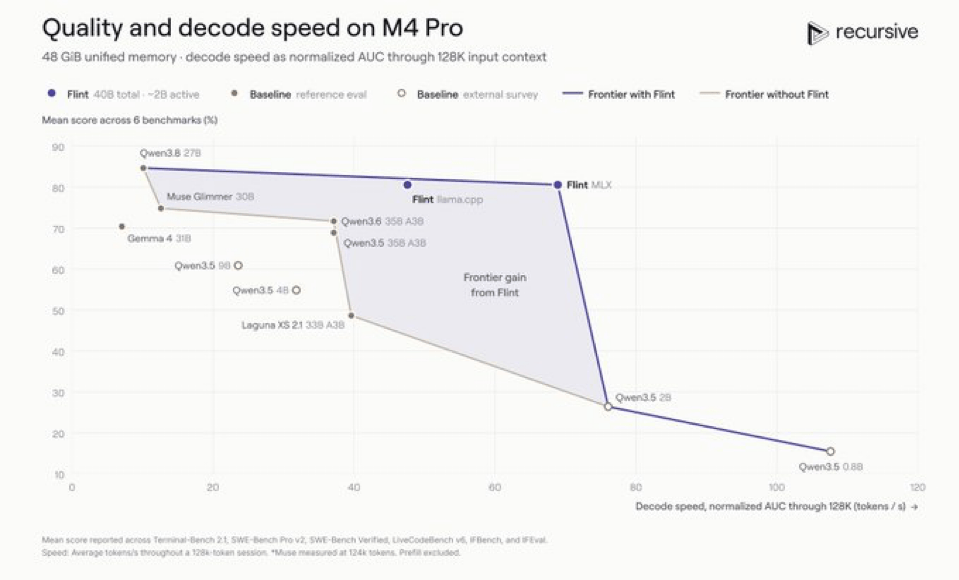 Mean score against decode speed on an M4 Pro, from Recursive's announcement.
Recursive's chart shades a "frontier gain from Flint" between the dense Qwen 3.8 27B, which is higher quality but slow, and the small Qwen 3.5 2B and 0.8B, which are fast but weak. Scores and speeds are Recursive's own, run on its hardware.