
Skyfall AI introduced SKY-001, which it calls "the first Engineering World Model," in an announcement thread by Sam Pasupalak. Skyfall says it beats GPT-6 Astra and every frontier model it tested on CAD and BIM tasks: 51 to 125x faster, 150 to 210x cheaper, and a higher IoU (intersection over union against a reference design). The team came out of Maluuba's deep learning lab, which Microsoft Research acquired, and spent 18 months on it. The pitch is that SKY-001 "lets you dream a physical object before you build it," and that the first "AI General Engineer" will be the backbone for autonomous manufacturing.
The CAD results
The models compared are SKY-001, GPT-6 Astra, Gemini 4, Qwen 3.8 Max, Kimi K3 and Grok 4.7; Skyfall's post names Claude Opus 5.5 among the frontier models tested too. The CAD charts, all per case:
| Model | Generation time | Cost | Mean IoU |
|---|---|---|---|
| SKY-001 | 3.9 s | $0.005 | 79.7% |
| GPT-6 Astra | 199 s | $0.75 | 79.1% |
| Gemini 4 | 253 s | $0.25 | 76.9% |
| Qwen 3.8 Max | 764 s | $0.30 | 34.4% |
| Kimi K3 | 439 s | $0.13 | 9.5% |
| Grok 4.7 | 1,250 s | $0.59 | no output |
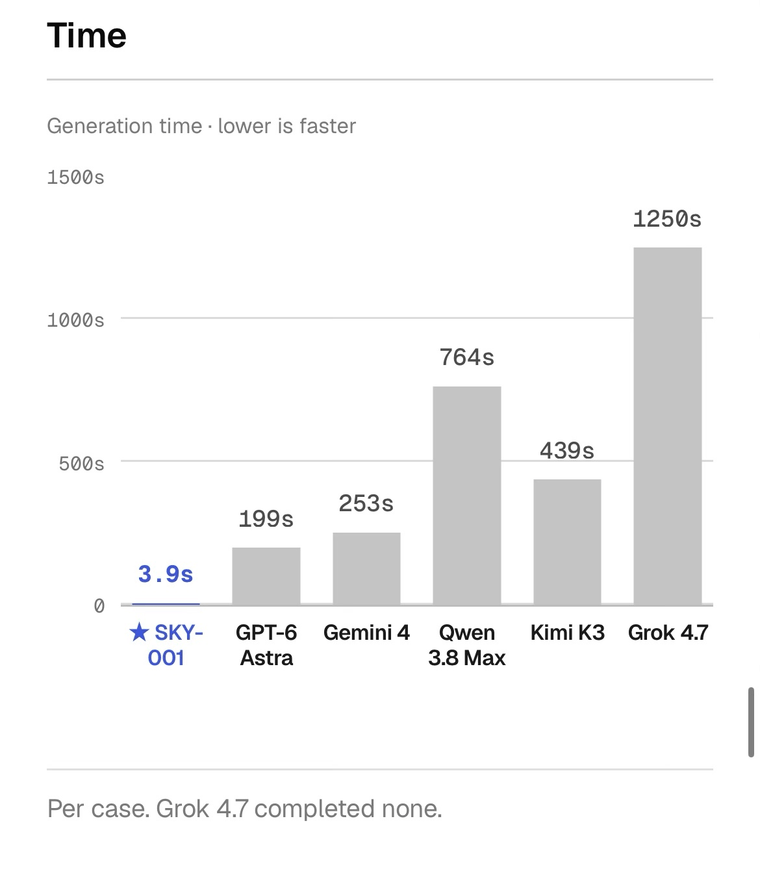 Generation time per case, from Skyfall's announcement.
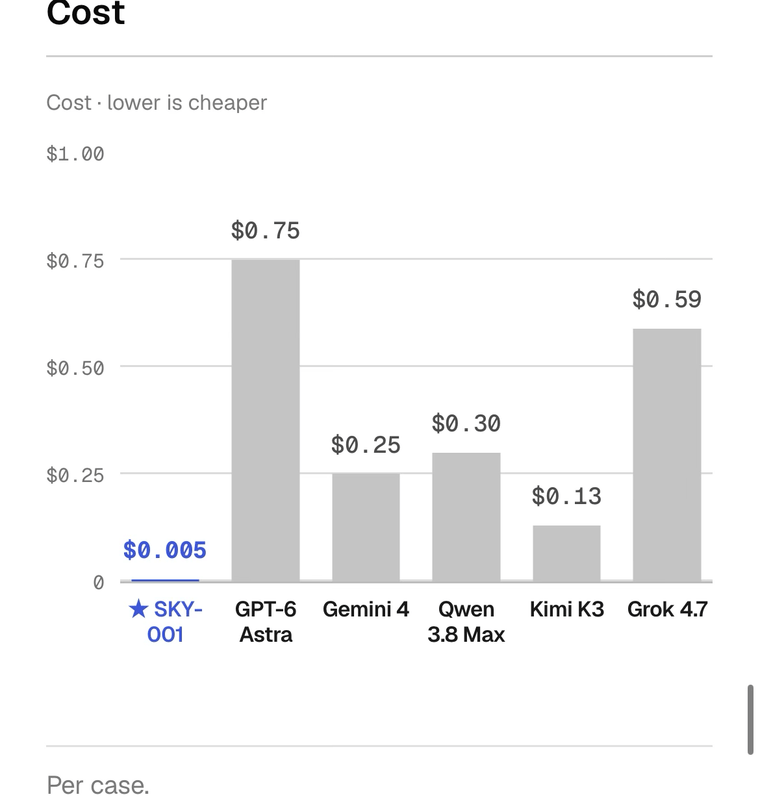 Cost per case, from Skyfall's announcement.
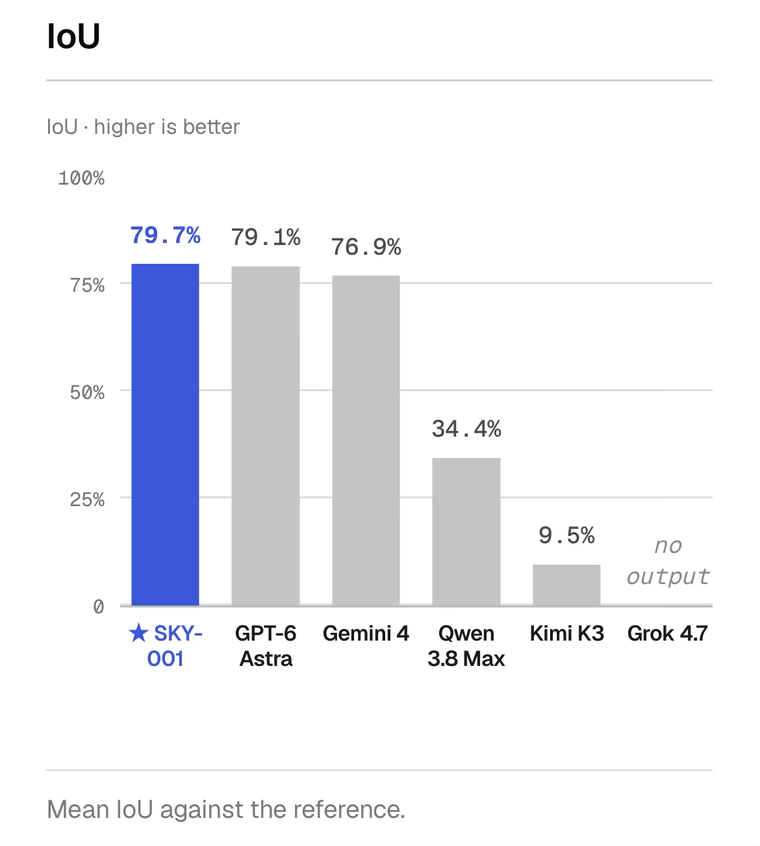 Mean IoU against the reference, from Skyfall's announcement.
The ratios from the CAD charts are 51x faster than GPT-6 Astra (199 / 3.9), 65x than Gemini 4, 113x than Kimi K3 and 196x than Qwen 3.8 Max. On cost, SKY-001 is 150x cheaper than GPT-6 Astra ($0.75 / $0.005), 60x than Qwen, 50x than Gemini 4 and 26x than Kimi K3, so the 150 to 210x headline matches only the most expensive model on the CAD chart. The accuracy lead is narrow: SKY-001's 79.7% IoU is 0.6 points above GPT-6 Astra and 2.8 above Gemini 4, and the gap only becomes large against Qwen 3.8 Max, Kimi K3 and Grok 4.7, which produced no output. In short, the result is parity in accuracy with the best frontier model at a small fraction of its time and cost. The thread cites BIM results too, but the charts shown cover CAD.
Why a world model
Skyfall argues the results confirm what it has said from the start: LLMs are autoregressive and predict one token at a time, but were never built for visual reasoning and long-horizon tasks. One-shot generation from frontier models looks impressive, since they know what goes into a sports car and can write CAD code with striking results, but zoomed in, internal assemblies are often simplified, missing or replaced with basic primitives.
SKY-001 plans each part before it is built. A 3D hierarchical part generation module breaks a complex physical object into smaller components, and a hierarchical sketch world model explains how each part is assembled, moving through 3D intermediate states, 2D sketches and CAD steps. Skyfall calls it a Compositional Visual World Model: it produces a visual plan of an engineered object. For another take on a world model that builds scenes rather than parts, see World Labs' Atlas.
What's next
The next step is pairing SKY-001 with a vision-language-action model (VLA). The agent would receive one component at a time plus the visual sequence to follow, execute each step, inspect the result and revise what fails. Because SKY-001 does the planning, Skyfall says even smaller open-source models could build complex CAD at far lower cost. The wider vision is to reinvent the physical economy beyond CAD and BIM, with PCB design, aerospace engineering, molecule design and energy and power grids as possible next domains.