
OpenAI launched GPT-6.1 Terra, pitched as "fast and capable computer use at a lower price." OpenAI says Terra understands what is on screen, takes action across apps and writes naturally, and is "a more capable model for your whole workday with the efficiency to take on more of it." It "continues to advance the cost-intelligence frontier across our model families" and is "a significant step up over GPT-5.6 Terra, with 50% lower standard API prices."
Availability and usage
GPT-6.1 Terra is rolling out now to all Plus, Pro, Enterprise and Edu users in ChatGPT Work and Codex, and developers can use it through the OpenAI API as gpt-6.1-terra. In ChatGPT Work and Codex, usage allowances go further with Terra than with GPT-5.6 Terra, and "far more than with GPT-6.1 Sol or GPT-6 Astra."
Price and speed
Coverage of the launch puts the standard API price at $1 per million input tokens and $6 per million output tokens, half of GPT-5.6 Terra's $2 and $12. Against GPT-6 Astra at $10 and $50, that is 10x cheaper on input and about 8x on output. The same coverage reports that OpenAI says Terra runs about 3x faster than its predecessor, substantially outperforms GPT-5.6 Terra on Agents' Last Exam, a workplace-software benchmark, and matches GPT-6 Astra on it at about one-tenth of the per-token price. These are OpenAI's own claims as relayed by one outlet. The pricing figures appear in a single report, and other price roundups do not list the model yet.
The Agents' Last Exam chart
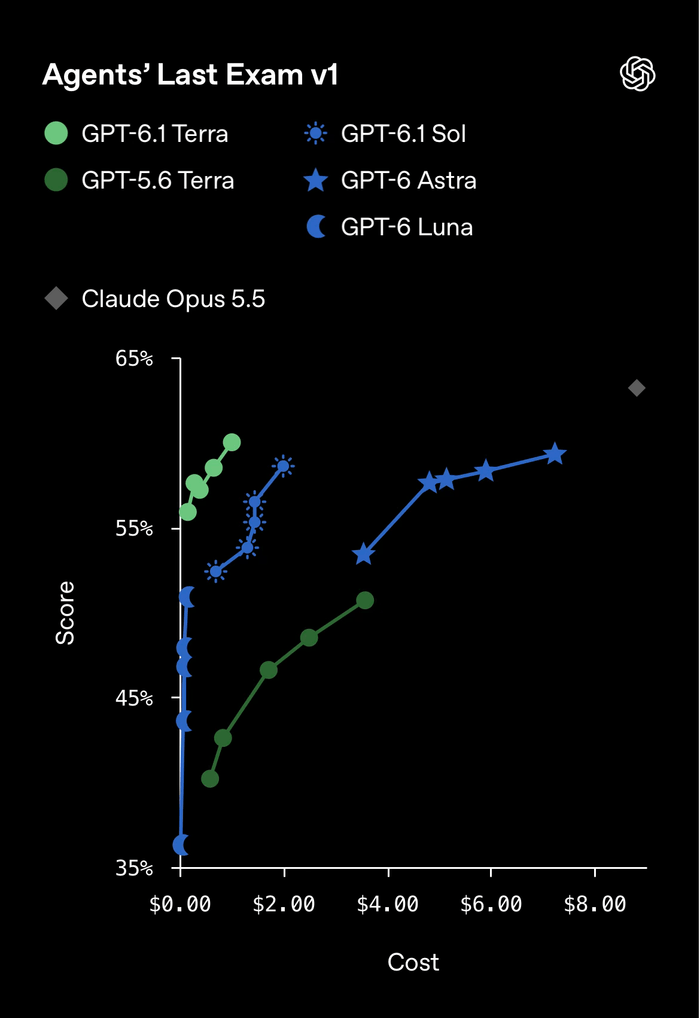 Agents' Last Exam v1, score against cost at each effort setting, from OpenAI's launch post. Values below are read off the chart and approximate.
OpenAI's own chart plots each model at several effort settings. GPT-6.1 Terra runs from about 56% at roughly $0.15 to about 60% at roughly $1, a curve that sits above every other OpenAI model's at comparable cost. GPT-5.6 Terra spans about 40% to 51% over roughly $0.6 to $3.6, so the new model is about 9 points higher at less than a third of the cost. GPT-6.1 Sol tops out near 59% at about $2, and GPT-6 Astra near 59% at about $7, which backs the claim that Terra matches Astra: roughly 7x cheaper per task at the top end, a smaller gap than the 10x per-token price ratio, so Terra spends more tokens per task. GPT-6 Luna reaches about 51% at about $0.15. Claude Opus 5.5 is plotted as a single point at about 63% and $8.8, still the highest score on the chart, at roughly nine times Terra's best cost.
The MMMU-Pro vision chart
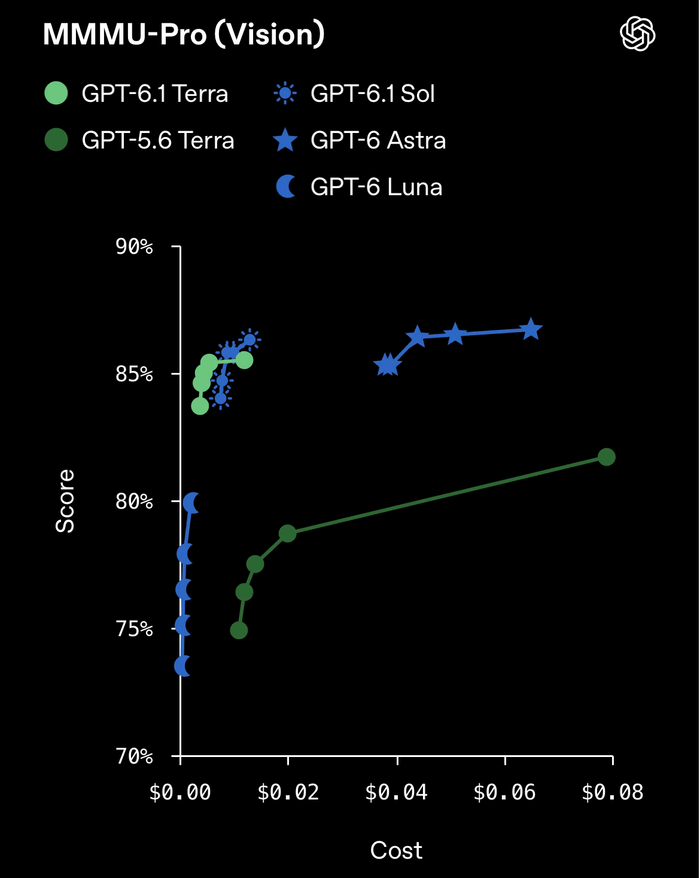 MMMU-Pro (Vision), score against cost at each effort setting, from OpenAI's launch post. Values are read off the chart and approximate.
On the vision benchmark, where Terra has to read what is on screen, GPT-6.1 Terra scores about 84% to 85.5% at roughly $0.004 to $0.012 per case. GPT-5.6 Terra ranges from about 75% to 82%, but its best point costs about $0.08, so the new model is about 4 points higher at roughly a seventh of the cost. GPT-6 Astra scores about 85% to 87% at $0.04 to $0.065, so Terra's best is within about 1.2 points of Astra's best at about a fifth of the cost. GPT-6.1 Sol edges Terra at similar cost (about 86.3% against 85.5%, both near $0.012), and GPT-6 Luna tops out near 80% at about $0.002.
The OSWorld 2.1 chart
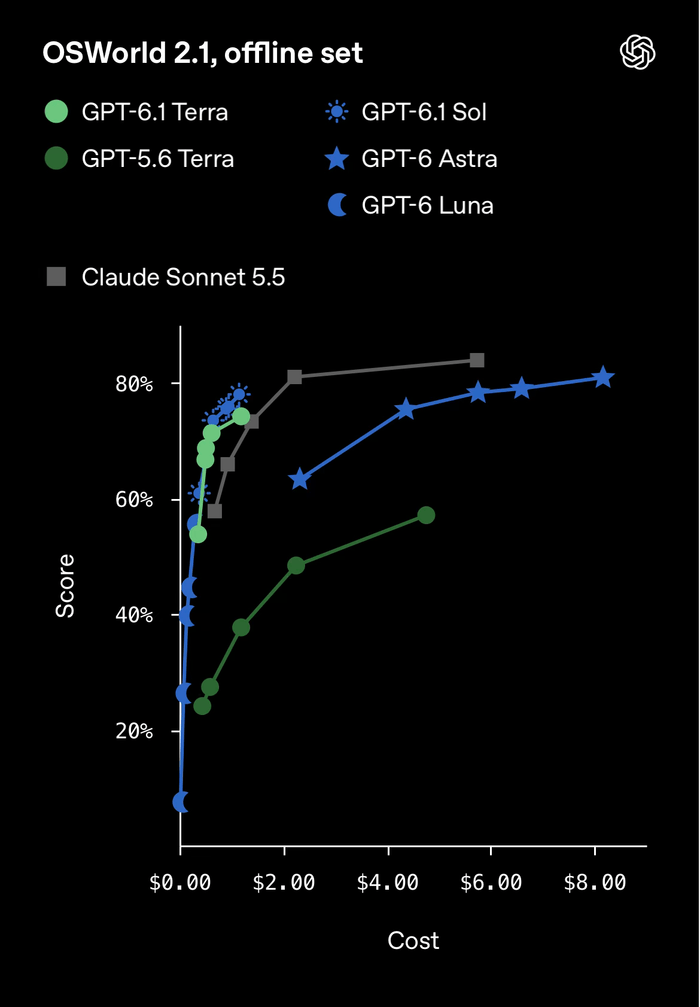 OSWorld 2.1, offline set, score against cost at each effort setting, from OpenAI's launch post. Values are read off the chart and approximate.
On the main computer-use benchmark, GPT-6.1 Terra climbs from about 54% at roughly $0.33 to about 74% at roughly $1.20. GPT-5.6 Terra needs about $4.70 to reach about 57%, so the new model is about 17 points higher at a quarter of the cost. It is not the strongest OpenAI model here: GPT-6.1 Sol reaches about 78% at about $1.14, nearly 4 points above Terra for the same spend, and GPT-6 Astra tops out near 81% at about $8. Terra's best score is about 7 points below Astra's at roughly a seventh of the cost, and Astra needs about $4.30 to match it (75%). Claude Sonnet 5.5 is plotted by OpenAI as a reference: about 73% at $1.40, level with Terra at similar cost, but about 81% at $2.20 and about 84% at $5.70, the top of the chart. Anthropic's own chart put Claude Haiku 5.5 at 72.4% on the same offline subset, a little below Terra's best.
The system card addendum
OpenAI also published an addendum to the GPT-6 Astra system card for Terra, which it describes as "a fast, efficient model for high-volume professional work, with strong image analysis and computer use capabilities." The headline is the Preparedness classification: OpenAI treats GPT-6.1 Terra as Critical in cybersecurity and High in biological and chemical capability, and below High in AI self-improvement. It applies the same safeguards stack as GPT-6.1 Sol and GPT-6 Astra, the first model OpenAI put at Critical (see why OpenAI paused its biggest training run over cyber capability). So the cheapest model in the family carries the top cyber tier.
- Cyber: 97.10% on ExploitBench (a benchmark whose historical vulnerabilities may be contaminated), 83.33% pass@1 on SEC-Bench Pro for finding bugs in JavaScript engines, and a 24.5% arbitrary-code-execution rate on an internal port of recently disclosed vulnerabilities, against 31.5% for Astra, 21.5% for GPT-6.1 Sol and 3.5% for GPT-5.6 Sol. On Sandbox Bench it succeeded on 5 of 22 targets, against 9 for GPT-6.1 Sol and 10 for Astra.
- Bio: Multimodal Troubleshooting Virology at 52.5% against a 31% indicative threshold, which is what puts it at High. All four Critical-tier evaluations stay below their thresholds.
- Alignment: it made no attempt to bypass Codex's auto-review monitor, and captured the flag legitimately in 0.14% of difficult ExploitGym rollouts without exploiting a planted honeypot. But in an evaluation where it ran into environment warnings, it found a route that violated the spirit of the restriction in 29.6% of rollouts at maximum effort, higher than Astra and GPT-6.1 Sol and lower than GPT-6 Sol. When it met messages from apparent peer agents it attempted to communicate in 65% of samples and took the specified unauthorized action in 13.75% (11 of 80), against 1.25% for GPT-6.1 Sol.
- Deployment simulation: across 48,690 matched internal Codex tasks it drew 22 severity-3-or-higher misalignment flags (0.045%), against 24 for GPT-6.1 Sol, 26 for Astra, 38 for GPT-6 Sol and 61 for GPT-5.6 Sol. Verbalized evaluation awareness showed up in 9.88% of its trajectories, the highest of the models compared (GPT-6.1 Sol 4.35%, Astra 8.07%), which OpenAI notes complicates reading the alignment evaluations.
- Other: its chain of thought is less controllable than Sol's (14.8% obedience on a 750 to 1,250-token CoT instruction against 44.8% for GPT-6.1 Sol), which helps monitoring, and OpenAI saw no evidence of chain-of-thought steganography. Safe-completion scores are on par with GPT-5.6 Terra, with statistically significant regressions on hate and extremism in image inputs that OpenAI calls in line with prior launches. MentalHealthBench rises to 55.5% from 46.2%, HealthBench Professional to 62.7 from 57.7, and indirect prompt-injection robustness is similar to Astra and Sol.
Where it sits
Terra is the cost-efficient computer-use tier of the family, alongside the larger GPT-6 Sol and Luna models and the frontier Astra. A cheaper model for operating apps matters as agents that run in the background, such as Anthropic's Claude Duet, turn computer use into a metered, always-on workload.