
Liquid AI introduced LFM3, "our new generation of Liquid Foundation Models," built for specialization and on-device deployment. With a new tri-hybrid architecture and new multimodal encoders, it comes as six model instances across text, audio, vision and omni modalities, generative and decision models, all built on LFM3-1.7B-Base and each fine-tunable on a single GPU. The model library lists them and Liquid AI's thread announced the launch.
The architecture
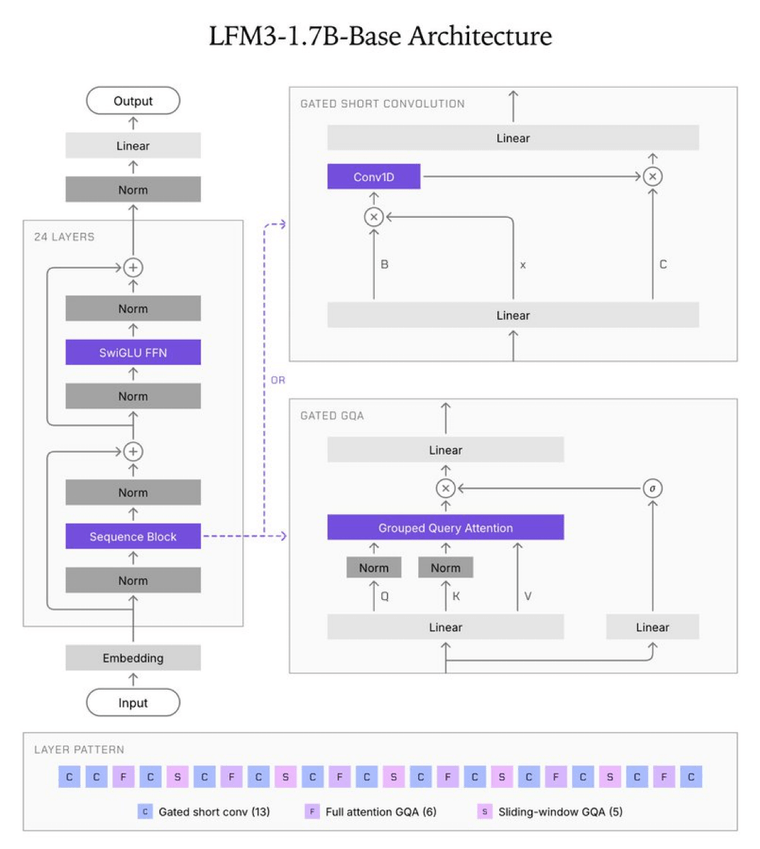 LFM3-1.7B-Base architecture, from Liquid AI's announcement.
The tri-hybrid design combines gated short convolutions, sliding-window attention and global attention: 24 layers, of which 13 are gated short convolution, 6 are full-attention GQA and 5 are sliding-window GQA. Liquid AI found it with its proprietary hardware-in-the-loop architecture search, which scores model quality alongside measured inference speed and memory use on target hardware. LFM2's search focused on phone and laptop CPUs; LFM3's covers 14 device and backend combinations, including the Galaxy S26 Ultra, OnePlus 15, Apple M4 Max, AMD Ryzen AI, a Raspberry Pi 5, Arm and x86 cloud CPUs, GPUs and the Qualcomm Hexagon NPU.
The six models
- LFM3-1.7B (text, 256K context): outperforms LFM2.5-2.6B with 35% fewer parameters, and its weights fit in about 1 GB at 4-bit. It is post-trained in agent harnesses such as Hermes Agent, Pi and OpenClaw, and beats Qwen3.5-9B on WebArena-Verified and AutomationBench. At 128K tokens its KV cache is 1.6 GB, against 4.3 GB for Qwen3.5-4B. To show scale, Liquid AI ran more than 300,000 LFM3-1.7B agents in parallel over the Enron email archive.
- LFM3-VL-2B (1.9B, vision-language): video input, step-by-step reasoning and spatial understanding. It averages 71.4 across 62 vision benchmarks, level with Gemma 4 12B, which is 6x larger, and Liquid AI calls it competitive with Gemini 3.5 Flash Lite and GPT-5.6 Luna. Its new in-house vision encoder uses about a third of the compute of SigLIP2.
- LFM3-Audio-2B: text or audio in, text, speech or both out, in 18 languages, with tool calls. A causal audio encoder processes the microphone while the user speaks. It scores 58.5 on Liquid AI's spoken tool-calling evaluation against 44.3 for Qwen2.5-Omni-3B, and the LiquidCodec tokenizer turns tokens into speech at about 87x real time on one Apple M4 Max CPU thread.
- LFM3-Omni-2B (2.2B): the first omni model, combining vision, audio and language. It scores 70.1 on Daily-Omni against 61.3 for Qwen2.5-Omni-7B.
- d1-2B and d1-Omni-2B: decision models that answer several questions about one input in a single forward pass with calibrated probabilities (Omni adds audio). New typed outputs cover bounding boxes and counts, text, number and date extraction with source spans (or "not found"), numeric estimates with a range, and multi-select answers with per-option probabilities. On Liquid AI's 117-benchmark index d1-2B scores 63.2 against 58.8 for d1-3B, with a third fewer parameters. See the d1 launch.
Speed and fine-tuning results
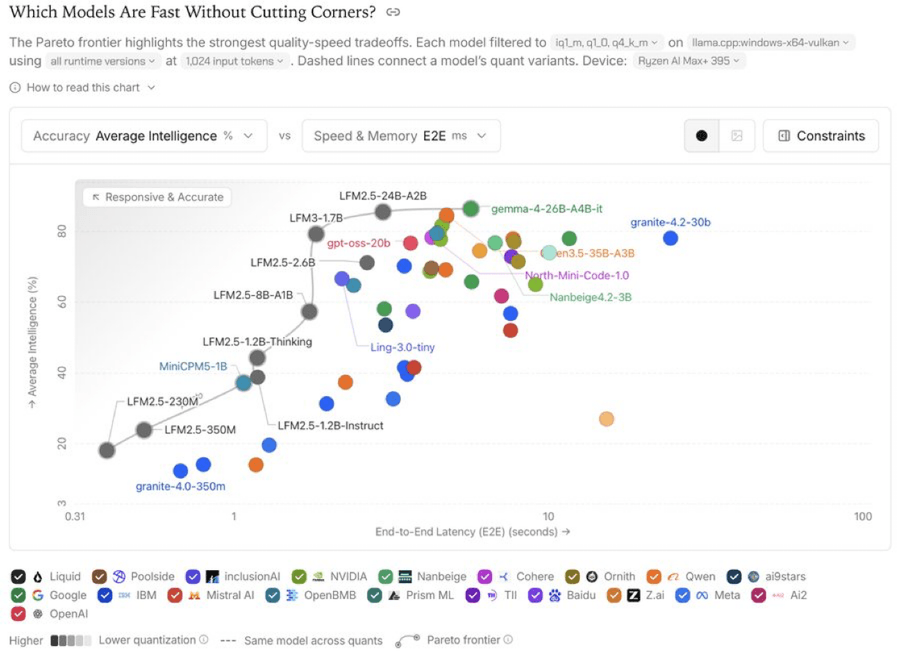 Quality-speed Pareto chart for device models (Ryzen AI Max+ 395, llama.cpp, Vulkan, 1,024 input tokens), from Liquid AI's pipette tool as shown in the announcement.
Liquid AI says LFM3-1.7B is number one on the Pareto frontier of device intelligence on its pipette.liquid.ai benchmark. In the chart it sits at roughly 80% average intelligence at under 2 seconds end to end, ahead of the larger LFM2.5-24B-A2B at about 86% in about 3 seconds and Gemma 4 26B-A4B near 87% in about 6 seconds, values read approximately off the chart.
For specialization, Liquid AI fine-tuned LFM3-VL-2B on about 3,000 public wind-turbine blade photos with SFT and GRPO in a few hours on one A100. On about 1,400 held-out photos, defect classification accuracy reached 67% against under 10% for both the untuned model and GPT-6 Luna, and detection F1 rose from 0.003 to 0.11 against 0.01 for GPT-6 Luna. For robotics, it reports 53% success on R2R and 43% on RxR navigation in unseen scenes under strict continuous control, and a manipulation VLA trained across 15 embodiments that averages 96.2% on the four LIBERO suites and 45.7% on RoboCasa-GR1 tabletop tasks, generating action chunks in under 50 ms on a Jetson AGX Orin.
Availability
Model cards are on Hugging Face: LFM3-1.7B, LFM3-VL-2B, LFM3-Audio-2B, LFM3-Omni-2B, d1-2B and d1-Omni-2B. Day-0 launch partners include AMD, Arm, NVIDIA, OpenRouter, Qualcomm, Vercel, Ambarella and Intel, with MacPaw, Mercedes-Benz and Shopify testing before release, and support across llama.cpp, MLX, Ollama, LM Studio, vLLM, SGLang, Unsloth and others. All benchmarks are Liquid AI's own. It follows LFM2.5-2.6B and the 24B-A2B model earlier this month.