
Deep Principle introduced Hydrogen-1.0, "our first open-weight model for scientific research," in a thread by Chenru Duan. The weights are on Hugging Face. It was made by post-training GLM-5.3 on domain data from chemistry, materials science and life sciences, together with records and agent trajectories from the company's own laboratories. Duan says it aims at "open scientific superintelligence for discovery," arguing that only open weights let researchers inspect, adapt and build on AI progress.
The numbers
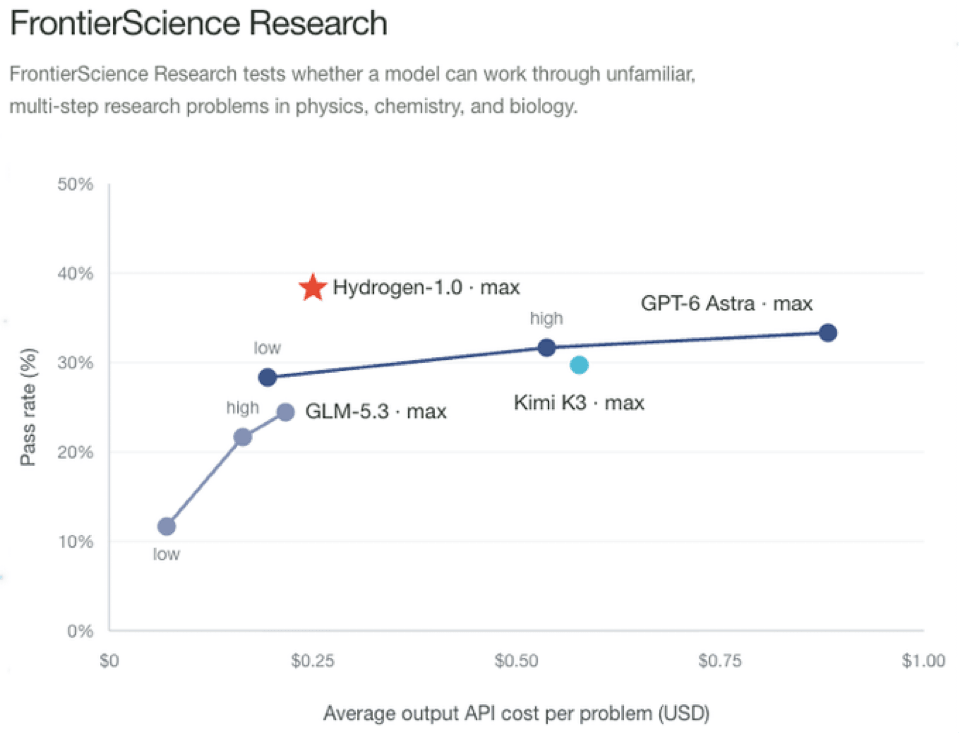 FrontierScience Research pass rate against average output API cost per problem, from Deep Principle's blog post. Values for models other than Hydrogen-1.0 are read off the chart and approximate.
- FrontierScience-Research: 38.3% against 33.3% for GPT-6 Astra at maximum thinking, the benchmark's test of unfamiliar, multi-step research problems in physics, chemistry and biology. In the chart Hydrogen-1.0 sits above every other point at about a quarter of a dollar per problem, while Astra needs about 88 cents for its best score. Kimi K3 is near 30% at about 58 cents and GLM-5.3 near 24.5% at about 21 cents.
- GPQA-Diamond: 93.0%, which Deep Principle calls on par with the state of the art. It says this improves on GLM-5.3 and roughly matches Kimi K3, at an API cost similar to GLM-5.3.
- Internal research scenarios: against Astra at maximum thinking, Hydrogen-1.0 scores 76.9% against 71.8% on scientific computing (5.13 points) and 90.5% against 85.7% on one-step forward reaction prediction (4.76 points), ahead at each of three thinking settings. Astra still leads on NMR structure elucidation, 30.0% against 26.7%, by 3.33 points. Deep Principle notes that absolute scores across these tasks reflect case difficulty and are not comparisons of capability.
- Materials design: in transition metal complex design, each model recommends new complexes over five rounds from the same starting population, seeing only the results of its own picks. By round five the mean best-so-far HOMO-LUMO gap is 4.318 eV for Hydrogen-1.0, against 3.689 eV for Astra and 3.353 eV for Kimi K3.
What it does
Deep Principle's examples are agentic research workflows:
- Molecular dynamics: it writes Python to build a polyethylene melt, runs GROMACS, detects and repairs a topology error and restarts, then analyzes the 40 ns trajectory for density, packing, diffusion and chain dimensions.
- Reaction networks: it maps an Ireland-Claisen rearrangement network of 27 structures through 30 plausible reactions, with competing branches and return paths.
- NMR: given seven candidate monoformylation products of 2-bromonaphthalene and a 1H spectrum, it works through the downfield and aromatic signals to assess each candidate.
- Experiment planning: trained on electronic laboratory notebook records, with intent, procedure, observations and outcome kept connected, it turns a one-sentence intent into an experimental plan and protocol.
Training
Training combines supervised fine-tuning on worked examples of reasoning, experiment planning, protocol design and results analysis with reinforcement learning on feedback about research outcomes. The data covers domain knowledge, scientists' task feedback, laboratory records and full discovery trajectories, including failed attempts. Post-training of the full mixture-of-experts model builds on Megatron and SGLang across NVIDIA CUDA and AMD ROCm.
Deep Principle frames the release against proprietary discovery work such as OpenAI's Navier-Stokes proof and Anthropic's enzyme discovery, whose underlying models are not open weights. All results are Deep Principle's own evaluations, and the internal tasks are not public.