
Meituan introduced LongCat-2.5, "our latest natively multimodal agentic model with 1.6T total parameters and ~48B active." It is built for long-horizon agentic tasks, with "stronger visual understanding and agentic coding" for work from complex coding projects to visual coding such as creative design and 3D tasks. Meituan's blog post builds on LongCat-2.0 in three areas: native vision, agentic reinforcement learning and infrastructure.
The benchmark charts
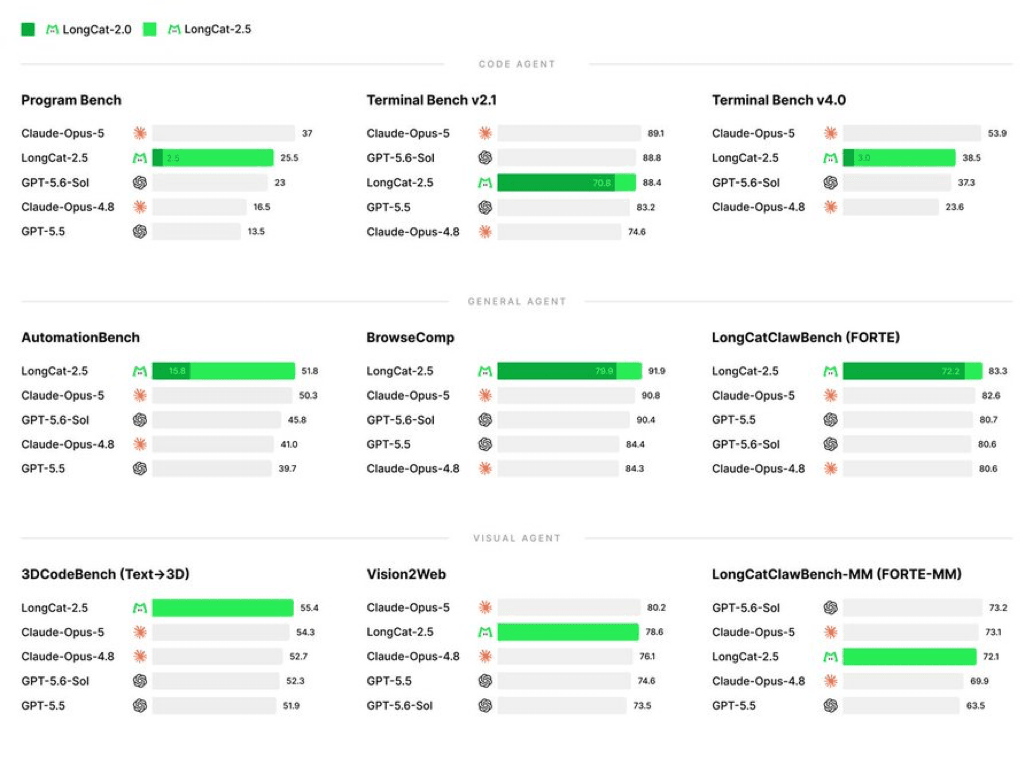 Meituan's comparison charts for LongCat-2.5, from its blog post.
Meituan compares LongCat-2.5 with GPT-5.5, GPT-5.6 Sol, Claude Opus 4.8 and Claude Opus 5. It leads four of the nine charts, is second on three and third on two:
- First: AutomationBench at 51.8 (Opus 5 at 50.3), BrowseComp at 91.9 (Opus 5 at 90.8), LongCatClawBench (FORTE) at 83.3 (Opus 5 at 82.6), and 3DCodeBench (text to 3D) at 55.4 (Opus 5 at 54.3).
- Second: Program Bench at 25.5 against 37 for Opus 5, Terminal Bench 4.0 at 38.5 against 53.9 for Opus 5, and Vision2Web at 78.6 against 80.2 for Opus 5.
- Third: Terminal Bench 2.1 at 88.4, just behind Opus 5 at 89.1 and GPT-5.6 Sol at 88.8, and LongCatClawBench-MM (FORTE-MM) at 72.1, behind GPT-5.6 Sol at 73.2 and Opus 5 at 73.1.
Against its predecessor, six charts show LongCat-2.0: AutomationBench rises from 15.8 to 51.8, Terminal Bench 4.0 from 3.0 to 38.5, Program Bench from 2.5 to 25.5, Terminal Bench 2.1 from 70.8 to 88.4, BrowseComp from 79.9 to 91.9 and LongCatClawBench from 72.2 to 83.3. The post notes a table with a broader set of models, which was not part of the material here. All figures are Meituan's own.
Native vision as tokens
LongCat-2.5 represents visual signals as multi-level discrete tokens, so the backbone handles images and text in one token format. Residual vector quantization is applied to native-resolution features from a Semantic-and-Aligned Encoder, as in LongCat-Next, and token IDs are precomputed offline, which removes the vision encoder from the training graph and makes modality load predictable across data-parallel ranks. Visual codebook embeddings are learned jointly with the backbone. In a preliminary check on a smaller MoE with about 3B active parameters, visual and text embeddings interweave in a shared space.
Meituan's showcase has eight demos generated end to end by the model, such as real-time fluid simulation, 3D digital exhibitions, city dioramas, business analysis and event invitations.
Agentic RL and multi-teacher training
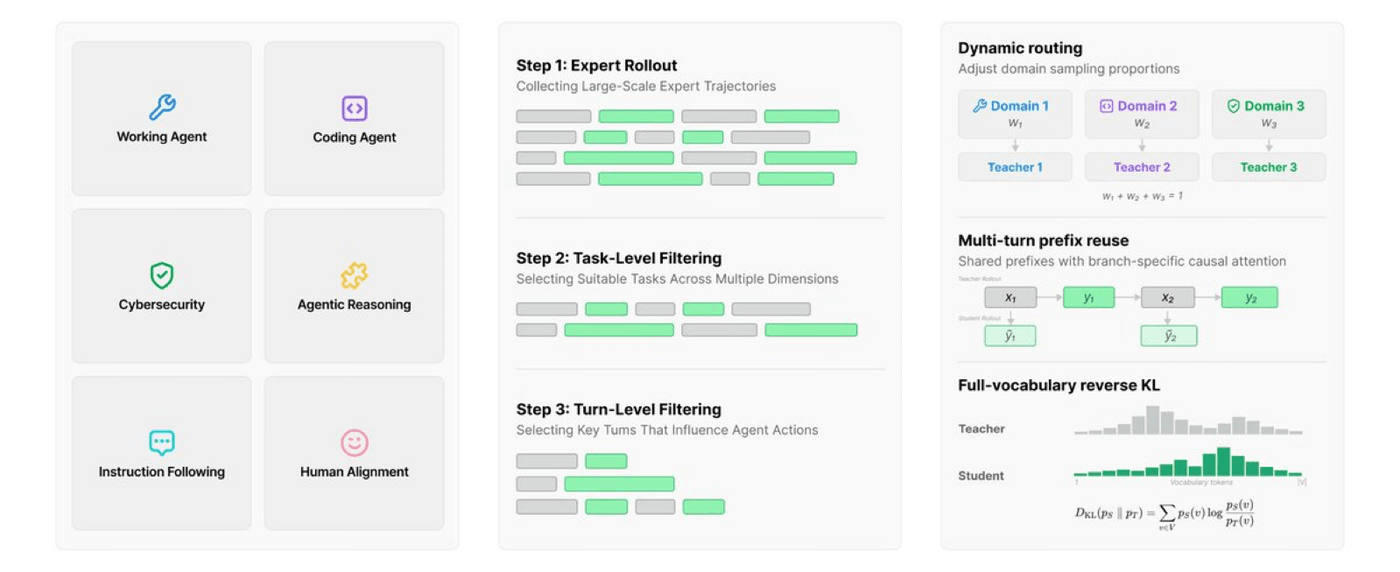 LongCat-2.5's expert groups, trajectory filtering and distillation, from Meituan's post.
- Data and environments: a synthesis pipeline filters GitHub pull requests and linked issues, has agents annotate tasks and build environments, and validates them with fail-to-pass and pass-to-pass tests. Real internal coding tasks add coverage, and agent failure trajectories from the real world become reproducible, verifiable training tasks.
- Asynchronous RL: partial rollouts with oversampling, filtering of groups where every rollout succeeds or fails, and clipping and rescaling to limit the bias from stale tokens generated by older checkpoints.
- Reward hacking: task environments have no network access and no git history or cached files, an LLM judge audits trajectories for exploits, penalties curb repeated reasoning and tool calls, and reward is redistributed among positive samples to counter growing response length.
- Mixed training: tasks aligned with different benchmarks are mixed with their scaffolds in varying proportions, and Meituan says gains across tasks reinforce one another.
- Multi-teacher distillation (MOPD): the model keeps LongCat-2.0's expert groups for agent, reasoning and interaction capabilities. The student samples online across domains and is trained by full-vocabulary reverse KL divergence. Per-cut prefixes and segment-capped student rollouts keep long responses stable, while shared prefill, KV-cache reuse and Tree Attention keep sampling and training cheap.
Infrastructure
Meituan trains long sequences on domestic AI accelerators with under 80 GB of memory each, aligning parallelism with the supernode topology. Its dual-shard FSDP reaches 86% higher per-device throughput than a DDP baseline in long-sequence SFT. It also reports bitwise-identical per-token log probabilities between training and inference despite different parallelism, and disaggregated prefill and decode for long-context rollouts, where a 3:2 prefill-to-decode ratio performed best in its test.
For inference it built a W4A4 solution that quantizes expert weights and activations to 4 bits on native INT4 units, with accuracy it says matches the unquantized model on all evaluated downstream tasks. Against a W8A8 INT8 baseline, online stress tests show prefill throughput up 43.3%, decode throughput up 42.77%, time to first token down 15.91%, time per output token down 19.72%, and a 1.73x average speedup on the grouped-matmul kernel.
The text provided does not state whether the weights will be released or under what licence.