
SenseTime introduced SenseNova-Loop-9B-Preview, "now open source," with the pitch of "scaling compute depth, not just model size." The code and weights are in the SenseNova-Loop repository. It is a multimodal language model for long-context and agentic work that takes text and images and generates text, covering document understanding, coding and interaction with external tools.
What SenseTime claims
- 27B-class performance: the 9B model "delivers 27B-class performance on complex tasks," outperforming Qwen3.5-27B on WorkBuddy Bench, RaccoonPPT Bench and AutomationBench.
- mHC gains: the manifold-constrained hyper-connections lift scores by 4.42 points on GPQA Diamond and 13.34 on TeamBench.
- Use cases: strong across coding, office and agent tasks, including interactive, animated HTML demos.
- Next: larger models, adaptive fast and slow thinking, and more efficient reasoning.
How the loop works
The decoder has 32 distinct layers. Layers 0 to 3 run first, then the block of layers 4 to 27 (24 layers) is applied twice in sequence with the same weights, then layers 28 to 31 and the output head. That is 56 decoder-layer computations per forward pass while storing only 32 layers of weights, a deeper path without duplicating the repeated block's parameters.
- Two-stream mHC: inside the looped section, learned mappings control how each layer reads from two residual streams, mixes them and writes its output back. Sinkhorn normalization constrains the stream-mixing map, with 20 iterations in the documented configuration.
- Hybrid attention: each group of four layers has three linear-attention layers and one full-attention layer, and the loop boundaries align with whole groups so the pattern holds across both passes.
- Execution configuration: the loop range, pass count and mHC routing are part of the checkpoint, so an inference implementation must load them and reproduce the execution order.
- Training: documented recipes combine long sequences, images, code and supervised task trajectories, up to 262,144 tokens.
- Speed-ups: the model supports multi-token prediction (MTP). DSpark and DFlash2 are in development, with training in progress. SenseTime says practical speedups depend on workload, hardware and serving setup.
The benchmark charts
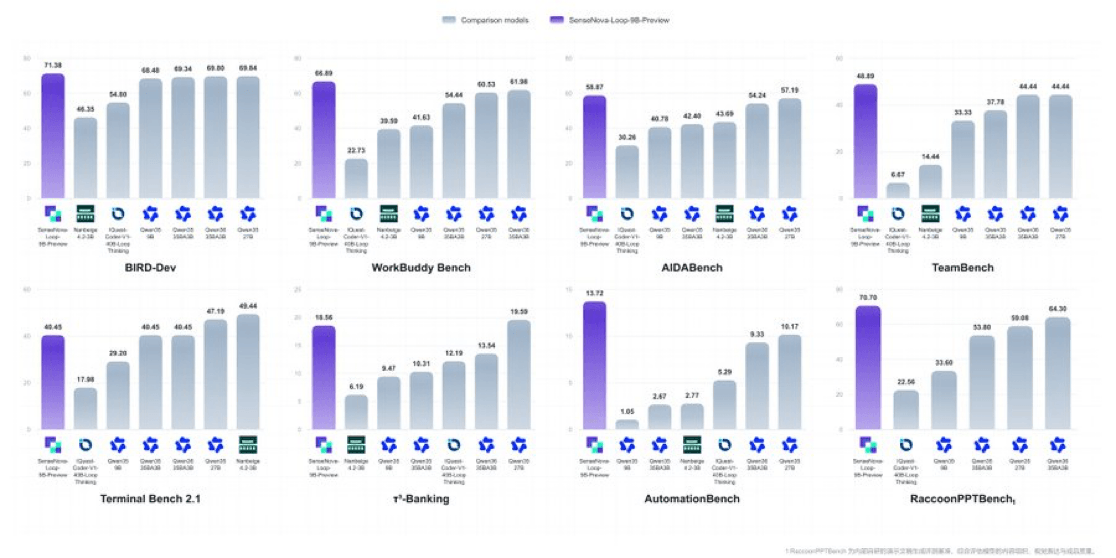 SenseTime's comparison charts for SenseNova-Loop-9B-Preview, from its announcement.
SenseNova-Loop-9B-Preview scores highest of the models shown on six of the eight charts: BIRD-Dev (71.38), WorkBuddy Bench (66.89), AIDABench (58.87), TeamBench (48.89), AutomationBench (13.72) and RaccoonPPTBench (70.70). It trails on Terminal Bench 2.1, where it scores 40.45 against 47.19 and 49.44 for the best two, and on tau-cubed Banking, at 18.56 against 19.59 for the top model. The comparison set is small models: iQuest-Coder-V1-40B-Loop-Thinking, Nanbeige4.2-3B, Qwen3.5 at 9B, 35B-A3B and 27B, and Qwen3.6 35B-A3B. The widest margin is on RaccoonPPTBench, about 6 points above the next bar. These are SenseTime's own results, with scores read from the chart, and the RaccoonPPTBench figures come from an internal benchmark.
It follows other small-model pushes this month, such as Nanbeige4.3-33B.